
Is there possibility to minimize "shadows" on flat surfaces?
Hello, I am printing lot of flat surfaces with holes etc.
What I noticed, printer creates lot of shadows when he skip some part of surface and start (for me it seems randomly) somewhere else. What I want to do is to minimize shadows, see picture:
Black dot are holes, what I want - is to green area to be printed at once, then the white areas (which will creates these "shadowy" pattern) on surface. Is that possible?

RE: Is there possibility to minimize "shadows" on flat surfaces?
You are describing ghosting or ringing effects. They're often created when the Y carriage (the big heavy bed) is moving at high enough speeds that it can't change directions quickly. The jerk & acceleration settings can be used to reduce this effect, though at the cost of print speed. For a simple test, start printing that part and just dial speeds back significantly (50%) using the front knob. The print will be slower, but those effects should be reduced. If that's true, try adjusting jerk settings.
RE: Is there possibility to minimize "shadows" on flat surfaces?
I know what ghosting is, what I means it appears only on top layer of print (not on side) like on this picture (I found on the internet) - where the print head started print there is visible "shadow" in 45 degrees angle. Almost on each bevel/emboss - what I am asking - if there is possibility to minimize them by printing one single area at once (calculated somehow) and then finish the small areas.


RE: Is there possibility to minimize "shadows" on flat surfaces?
This is a known issue with Prusa Slicer and has several issue reports requesting a fix. So far the devs rate it a 'don't care' issue.
https://github.com/prusa3d/PrusaSlicer/issues/2556
ps: more comments like yours about it at GitHub will refresh the topic.
RE: Is there possibility to minimize "shadows" on flat surfaces?
Hi,
you can avoid the shadows with a sacrificial 0.2 mm Layer on the holes.

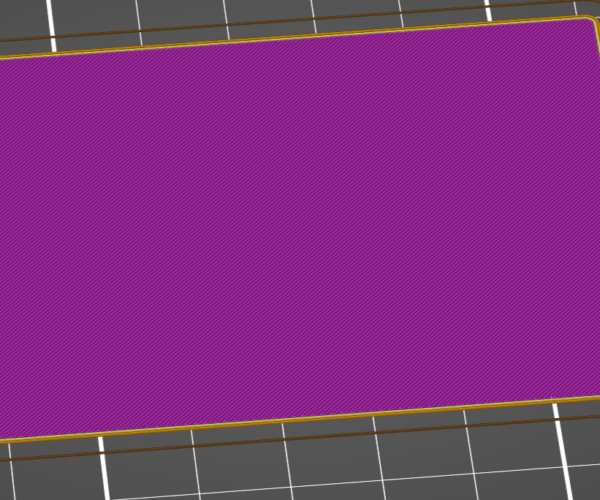

After printing you can remove the first 0.2 mm layer with a knife oder drill etc.
RE: Is there possibility to minimize "shadows" on flat surfaces?
[...] you can avoid the shadows with a sacrificial 0.2 mm Layer on the holes.
An elegant solution! Following the thread on GitHub, it does appear that this is getting active attention from the devs.
RE: Is there possibility to minimize "shadows" on flat surfaces?
Hi,
you can avoid the shadows with a sacrificial 0.2 mm Layer on the holes.
This is not addressing the problem: and have you ever tried removing a layer of plastic on a part? Many times the top surface is there because it has to be there - supports, part complexity, etc. And adding an extra layer to drill through doesn't help with complex hole shapes or multiple angles on the part (non-rectangular, multiple levels, odd shapes).
RE: Is there possibility to minimize "shadows" on flat surfaces?
This is not addressing the problem: and have you ever tried removing a layer of plastic on a part?
Gotta admit, the sample results shown are pretty impressive though. A work-around for sure, but one that works for that situation.
I've noticed that many in the 3D printing community are expecting the printer to produce 100% finished products. Back in the days of working with wood, fiberglass, Xacto-knives, sandpaper and paint, you'd always expect to have to do some final finishing to get a polished product. I've seen some FFF prints made into amazing pieces by skilled crafts-folk who apply the same techniques.
Following the GitHub threads, it looks like the issue is getting attention.
RE: Is there possibility to minimize "shadows" on flat surfaces?
@tim-m30
Well I'm sure that this isn't a solution for the cause of the Problem, but it's a nice workaround to get easy and fast a even first layer surface.
And yes please see the pictures above, I removed many "unbelievable" thick 0,2mm first layers of any kind of round or square holes.
RE: Is there possibility to minimize "shadows" on flat surfaces?
Sure it works for a flat plate - but if the plate has any protrusions, like a raised grommet on one of those holes - the method breaks. The only real fix is for the slicer to get smarter and allow unidirectional infill.
ps: this comes from years of experience managing software groups that if a workaround shows up for a defect it immediately reduces the priority of said defect. So my knee jerk reaction is to counter any work-around if it doesn't fully solve the issue.