
So what's the solution for this? (build plate adhesion to the heat bed)
I am printing a 6 inch wide by 6 inch tall bucket for my kayaks dry well out of ASA filament. It's a 24 hour print and I got up this morning (about 6 hours into the print) to find that happily the whole thing has stayed firmly attached to the build plate but unhappily, it has literally lifted the build plate off the heat bed?
I have the chamber temp set to 55 but it has not been able to get over 49 degrees so not sure what more I can do to keep the temp higher inside to reduce the asa trying to warp. Does this just mean I can't use ASA for larger prints with the core one?
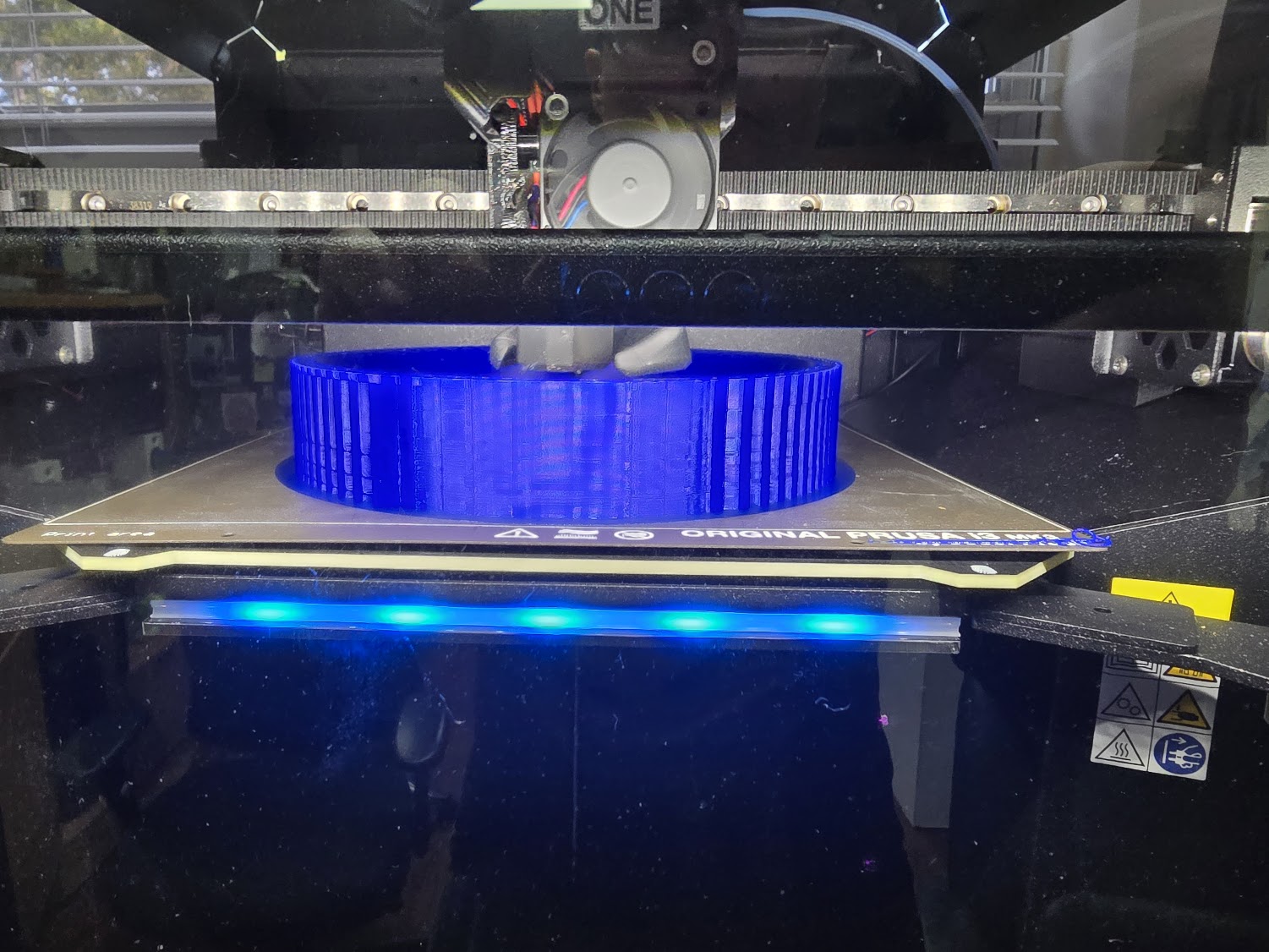

RE: So what's the solution for this? (build plate adhesion to the heat bed)
That's always tricky with ASA.J
ust a few key figures before I get my statement wrong.
- What is the print speed?
- How many perimeters?
- What kind of infill?
- What were the bed and nozzle temperatures?
Mods for Core One: Core One HT 450 degrees, Comfortable display , Very fast print start and Reducing noises
Mods for Prusa XL: Very fast print start

... and what is the ambient temperature?
Cheerio,
RE:
Thanks!
What is the print speed? 300ms
How many perimeters? 3
What kind of infill? gyroid 20%
What were the bed and nozzle temperatures? bed=100 nozzle=260 chamber nominal=60 minimal=45
solid layers bottom=5
ambient=74 f
Using the prusament asa profile
RE: So what's the solution for this? (build plate adhesion to the heat bed)
What is the print speed? 300ms
Do you mean 300 mm/s? Or 30 mm/s?
Mods for Core One: Core One HT 450 degrees, Comfortable display , Very fast print start and Reducing noises
Mods for Prusa XL: Very fast print start
RE: So what's the solution for this? (build plate adhesion to the heat bed)
I've never been quite sure which number in prusa slicer is the "print speed" setting people refer too? Theres about 20 different "speed" settings under the "speed" menu in prusa slicer and none of them are called just "print speed"
the 300 number i gave you is what "max print speed" is set too and I see print speed ratings between 300 and 600 all the time so assumed that is the one. What is the specific name of the "print speed" number your looking for? for example, perimeters is set to 70 but infill is set to 120? It doesn't list an overall print speed for the whole print that I can find?

RE: So what's the solution for this? (build plate adhesion to the heat bed)
Really it all comes down to max volumetric flow speed in mm^3/s. Calculating this depends on a few things. If the maximum print speed for a filament is (for example) 100mm/s f\then the max volumetric speed is (maybe... which I'll explain in a minute) for a 0.4mm nozzle and 0.2mm layer lines: 9 mm^3/s [100mm/s * 0.45mm (extrusion width) * 0.2mm (layer height)]. For a HF nozzle you can double that so 18mm^3/s. However.... You need to actually calibrate this using a flow test rather than simply plug in those numbers. So you create a flow test around that number and measure where the flow starts to under extrude. This test is built into OrcaSlicer.
RE: So what's the solution for this? (build plate adhesion to the heat bed)
HF nozzles don’t double the max.volumetric speed just like that if you're using the same hotend. That's marketing bullshit supplied by the manufacturers of these nozzles. In real world you gain maybe 10-25% of max.vol. speed depending a lot on the geometry of the model. You get also much higher chances of nozzle clogs ( and good luck performing effective cold pulls with a HF nozzle.. ).
RE:
HF nozzles don’t double the max.volumetric speed just like that if you're using the same hotend. That's marketing bullshit supplied by the manufacturers of these nozzles. In real world you gain maybe 10-25% of max.vol. speed depending a lot on the geometry of the model. You get also much higher chances of nozzle clogs ( and good luck performing effective cold pulls with a HF nozzle.. ).
Yes, that is true which is why you have to take that number and wrap a volumetric flow test around it to get the "real" number. So if you have a 9mm^3/s flow for a regular nozzle then run a test for the HF nozzle using a range of 10-25 (for example). Based on my testing for various filament types (especially PC) the number is much higher than a 10-25% increase.