
Linear Rail Lubrication - need more details?
I am now due for my first linear rail lubrication since I purchased my Core One fully assembled.
Where can I find better detail and photos than the Core One Maintenance page:
https://help.prusa3d.com/article/regular-printer-maintenance-core-one_829710
I tried google for about 15 minutes, and all I find is other model printers, sometimes other brands.
I have the official lubrication kit, but I can't find the needle ports on the carriage. I need a photo
or video to show me where to insert the needle into what port?
Thanks in advance for any help, mentoring, guidance.
Neal

RE: Linear Rail Lubrication - need more details?
Larger THK linear rails actually have grease nipples installed, but ours are small so just have a hole. Do a Google image search on THK linear rail lubrication hole and you'll see many images showing the grease nipples on each end. Our hole is in the same spot.
RE: Linear Rail Lubrication - need more details?
To make sure I understand, I see more than one hole on the side edge of the carriage, behind the two belts.
Shining a flashlight now, OH, ok, two of these are small phillips head screws. So I assume the center one
is the lubrication hole?
Question: Do you just carefully navigate the lubrication needle in between the two belts and into that hole,
then inject the 0.1 amount that is indicated in the instructions? I assume I should drape some kitchen plastic wrap
over the two belts, so that the lubrication needle can't get any microlube onto the belts?
Really surprised that Prusa does not have documentation with photos about this step. I purchased the printer assembled,
and there is no way for someone in my position to follow the Prusa lubrication help note at that link above, and
figure this out unless they consult this forum or make a support ticket.
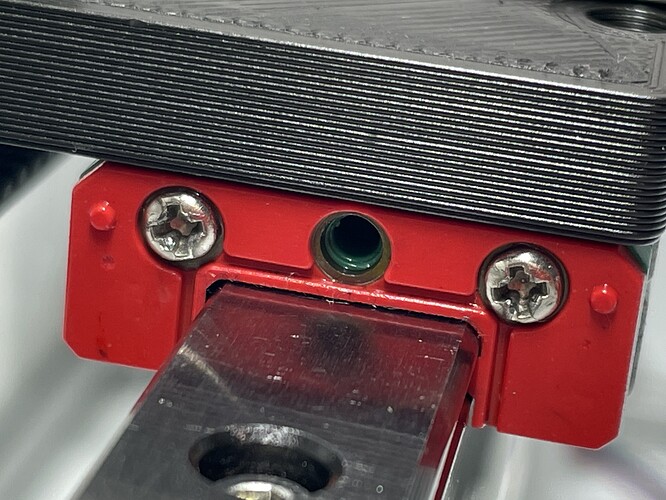
As you suggested, I looked on google image search. Ignoring the red color, in this photo below,
is the lubrication hole the one that is centered between the two screws? On the Core One, would
this be directly in the center on the side of extruder carriage, in between the two belts?
Thanks,
Neal
RE: Linear Rail Lubrication - need more details?
Yes, that's the hole. I've yet to do the lube so I don't know how hard access and visibility are. I do know that the rubber in the belts is not very tolerant of hydrocarbons like oil and grease, so I'd slip something in to avoid getting lube on them.

RE:
This is a timely thread for me. I've received my lubrication set and need to stop procrastinating and get on with this too.
Thanks OP for asking, and @conrad for the tips

RE: Linear Rail Lubrication - need more details?
https://help.prusa3d.com/guide/how-to-lubricate-linear-bearing-rails-xl_384273
Core One L
RE: Linear Rail Lubrication - need more details?
Thanks. While waiting for a reply like above, I just got off a chat with Prusa Tech Support, and they were amazingly helpful. They also shared the same link.
That link for the XL is the same style linear rail with the same lubrication port hole in the side center.
Neal
RE: Linear Rail Lubrication - need more details?
In order to help other people doing this for the first time, I want to share a Tech Support Chat:
[Neal]
Where can I find better detail and photos than the Core One Maintenance page: https://help.prusa3d.com/article/regular-printer-maintenance-core-one_829710
[Prusa]
https://help.prusa3d.com/guide/how-to-lubricate-linear-bearing-rails-xl_384273
This is for XL, but has better pics and linear rails are similar.
[Neal]
OK, I just now reviewed that: Question: Do you just carefully navigate the lubrication needle in between the two belts and into that hole, then inject the 0.1 mL amount that is indicated in the instructions? I assume I should drape some kitchen plastic wrap over the two belts, so that the lubrication needle can't get any Microlube onto the belts? In order to avoid going between the 2 belts from the front, and instead go from the top and behind the belts, I would need to remove the top cover of the printer. Is this the preferred approach?
[Prusa]
It is easier if you remove the top cover, but how you access the lubrication hole is up to you.
Just be very careful to not get any lube on the 2 belts. It definitely safer with the top removed.