
RE: Gantry resonant mode and VFA artifacts
That's absolutely a risk I'm trying to avoid, too. Those bearings aren't cheap.
but in the same way, like both at 92 degrees. I think it's typical for parts from the same batch to look like that.
Absolutely - designed for symmetry - systematic error cancels out and everybody is happy (except the bearings...)
RE: Gantry resonant mode and VFA artifacts
After some searching: is it so that belt interaction with the drive pulleys is the main cause of VFAs? It would match the tooth spacing on the belt.
This would be easy to separate from dynamic effects such as resonance by simply slowing down the print. There is a 68-page thread to be read...
Not sure whether there is a consensus... My favorite hypothesis is that imperfect meshing of the belt teeth with the pulleys is exciting a vibration, but that it takes a resonance (somewhere else) to amplify the vibration at certain speeds to produce pronounced VFAs. Oscillations of the gantry/bracket/belt system, as suggested by @huggypanda, seem like a very plausible candidate for such a resonance -- especially since they would cause a transverse motion of the nozzle, causing those "wavy walls".
Although, as mentioned earlier, I am wondering why we don't see more pronounced VFAs towards the sides of the printable area then, and less near the center. That's what I would expect from a wobbling/rotating gantry movement.
I wondered about that, too. I think what's happening is rotating the gantry causes uneven stress on the belts and that in turn causes uneven stress on the print head, making it wobble. For what it's worth, I *do* see a little bit worse behavior near the edges but it's very subtle at best.
RE: Gantry resonant mode and VFA artifacts
I do keep coming back to the VFAs being at the belt tooth pitch and not being 100% sure why. Reading the belt manufacturer's fine print, the pulley geometry might not be absolutely optimal for the tooth design. I know people have used different pulleys, but I've never heard of any revelation in that department.
I also think that it's uneven travel related to the tooth pitch which excites the VFA-related motion. But it probably takes some mechanical resonance to amplify it at certain speeds, or to translate it into a print head deflection orthogonal to the main travel direction, to make the VFAs noticeable.
As you say, results obtained by switching to different pulley specimens, different pulley brands, different belt types etc. seem to be hit or miss. I guess those toothed belts were never meant for precision positioning at the level we want in 3D printers (and with dynamic loads on top of that). They are probably operated outside of their specification in this respect. So changing components is always a bit of a gamble. Maybe one just has to play often enough to finally hit a lucky component combination...
Yeah I feel like if possible the best choice is always to not excite a resonance in the first place. I think that discussion's been done to death on another thread: consensus seems to be the excitation has /something/ to do with the belt, maybe the pulley, maybe the tolerances in the teeth, maybe the belt pitch. I absolutely am going to try every one of those recommendations, too, but it's a lot.
RE: Gantry resonant mode and VFA artifacts
One more thought/question: If the underlying mechanism is a torsional oscillation as (very plausibly) suggested by @huggypanda -- wouldn't one expect to find stronger VFAs towards the left and right side of the print bed, and weak or even no VFAs right in the center? But I don't think that is what we observe on the Core One.
Of course one could also envision a lateral oscillation instead (i.e. a parallel displacement of the whole gantry). I don't think any of huggypanda's experimental findings rule that out so far. Intuitively I would say that the torsional motion, with a lower resonant frequency, "feels more likely" -- but can it explain the constant VFA amplitude across the whole X range?
Any thoughts?
The flimsy L brackets form a torsional spring and the belts act like another set of springs. The resonant frequency should be related to those spring constants and the moment of inertia of the bar about that axis.
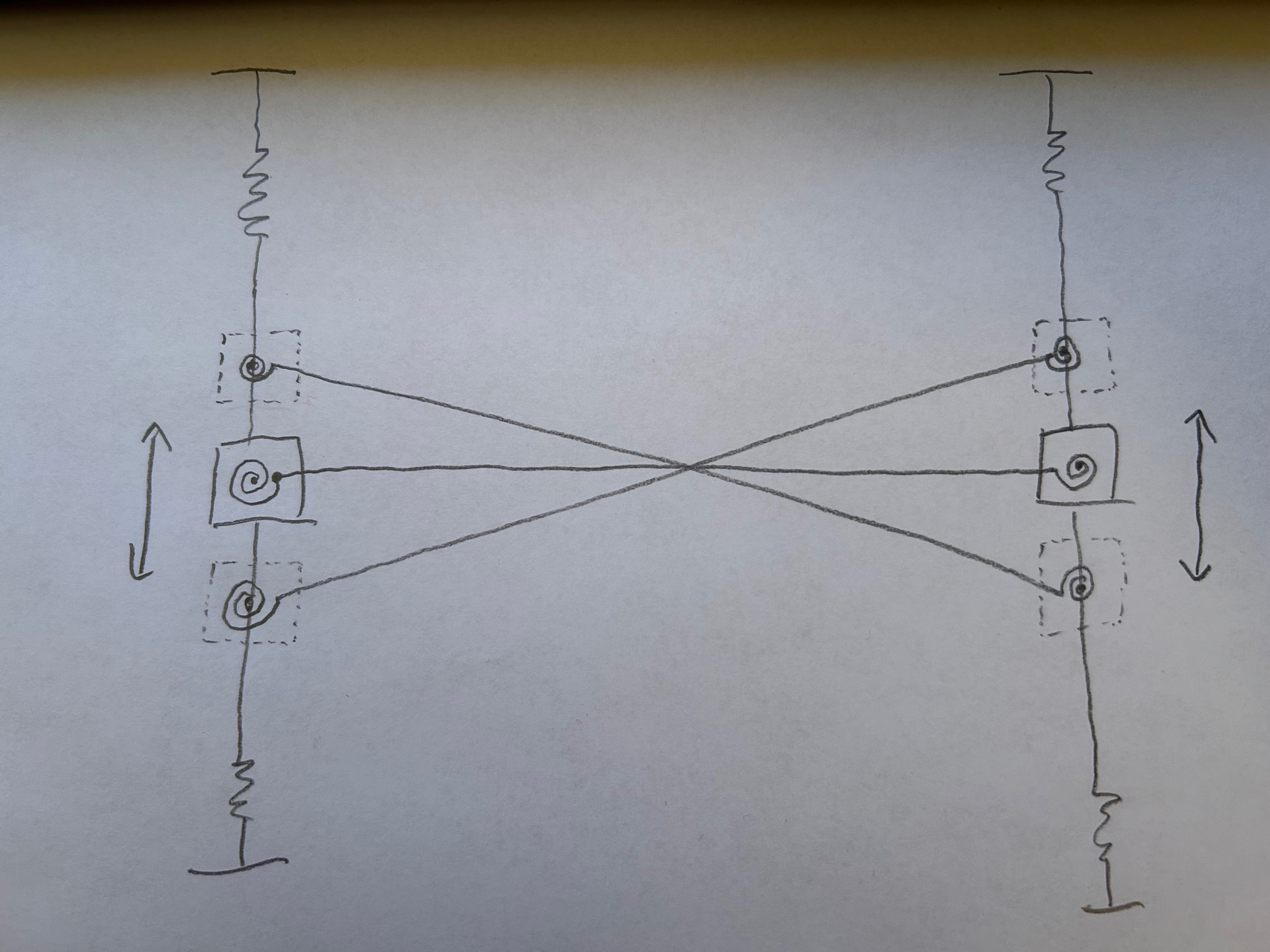
I agree, not ruled out. A small accelerometer probe is the best way to figure that out, but I don't have one at home.

RE: Gantry resonant mode and VFA artifacts
I am currently trying to design and print a complete printed part.
I am merging the curved mounting bracket, the deflection pulley mount, and the linear bearing housing into one part.
Of course, plastic cannot replace aluminum or steel, but I think PPA-CF, PPS, PEEK, or PCCF come close.
Mods for Core One: Core One HT 450 degrees, Comfortable display , Very fast print start and Reducing noises
Mods for Prusa XL: Very fast print start

RE: Gantry resonant mode and VFA artifacts
Just a thought on why we don’t see more VFAs towards the edges with this theory. In my view that would assume the x-axis is infinitely stiff, in reality while it may be stiff the nextruder is the relatively heavy weight the x-axis needs to move on y-moves, any flex in the x-axis from high y-acceleration could at least in theory flex the x-axis. If that happens I am not sure which resonating spring would dominate the VFAs.
/Anders
RE: Gantry resonant mode and VFA artifacts
Update:
I got some aluminum shims and screwed them down fairly tight as suggested by another poster here. This pushed the resonance up to ~120 Hz but I could get it no higher than that. Artifacts are still very visible on "normal" prints (i.e., not test prints), so fairly disappointing results overall.
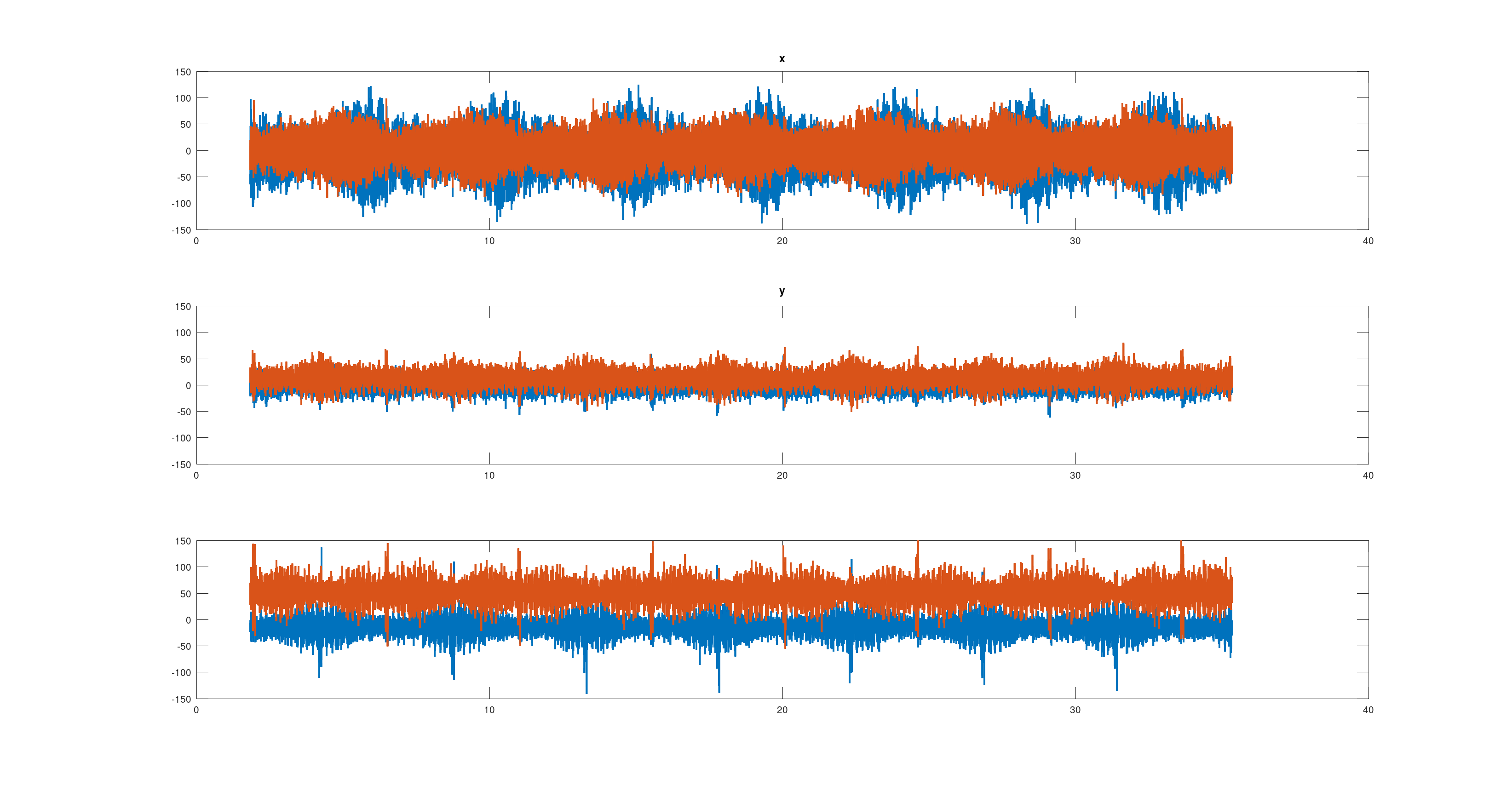
I also attached two accelerometers to the extreme arms of the gantry. Quick conclusion: it's apparently NOT torsional, at least not about the vertical axis. It could be torsional about the length of the gantry itself but I don't have measurements that would show that. Given the low frequency of ~45 Hz that seems unlikely to me.
In these plots, x axis faces the front of the printer (perpendicular to the gantry), y axis to the left and right (parallel to the gantry) and z axis (vertical). Data is sampled synchronously at 400 Hz. This data was collected while printing a thin vertical feature oriented so the print head is moving left and right. The turning points are most visible on the z axis.
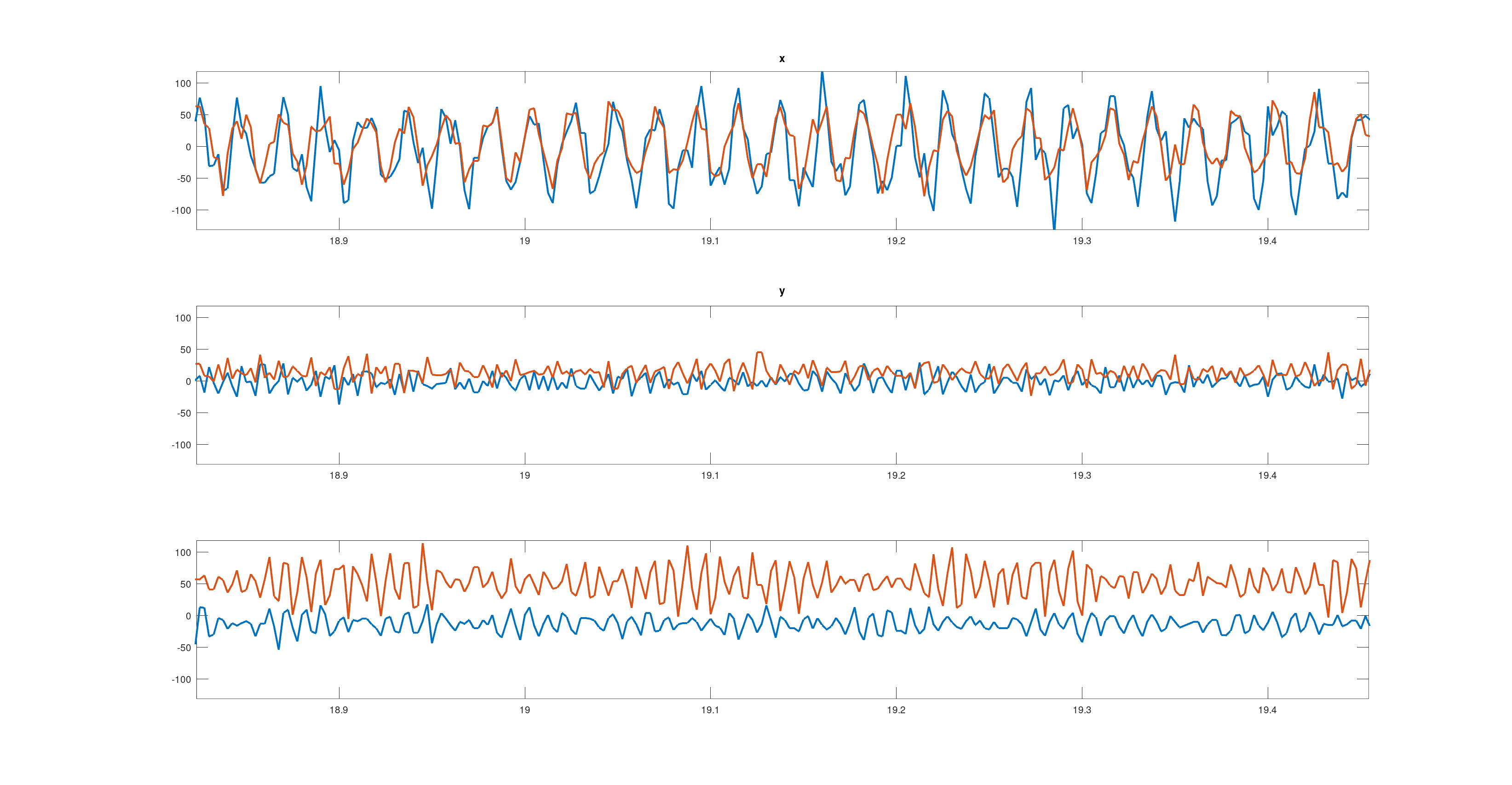
The x axis has most of the motion and zoomed in they are almost exactly in phase. So NOT torsional about the vertical axis, because then they would be out of phase. At least from this it is looking most like a simple spring-supported rigid body mode predominantly vibrating along the smooth rails. I don't know why shimming moved the resonance up so clearly. Mysteries.
And zoomed in:
RE: Gantry resonant mode and VFA artifacts
If it's quick for you to try I would love to know the results. But please check my latest reply -- mode is apparently not torsional so the extra rigidity may not help. Still not clear why shimming made such a difference.
I am currently trying to design and print a complete printed part.
I am merging the curved mounting bracket, the deflection pulley mount, and the linear bearing housing into one part.
Of course, plastic cannot replace aluminum or steel, but I think PPA-CF, PPS, PEEK, or PCCF come close.

RE: Gantry resonant mode and VFA artifacts
Excellent to see some accelerometer data. I notice that the frame of my Core One flexes quite a bit while printing. It's on a fairly rigid surface, so the bottom doesn't move much (calibrated light finger touch), but the top of the frame seems to move a good fraction of a mm at times. Have you stuck an accelerometer anywhere on the frame? I assume the important motions are difference motions between the build plate and the Nextruder, even if everything is shaking in the wind.

RE: Gantry resonant mode and VFA artifacts
Thanks for testing it further! Was the accelerometer test made without the shims?
Update:
I got some aluminum shims and screwed them down fairly tight as suggested by another poster here. This pushed the resonance up to ~120 Hz but I could get it no higher than that. Artifacts are still very visible on "normal" prints (i.e., not test prints), so fairly disappointing results overall.
I also attached two accelerometers to the extreme arms of the gantry. Quick conclusion: it's apparently NOT torsional, at least not about the vertical axis. It could be torsional about the length of the gantry itself but I don't have measurements that would show that. Given the low frequency of ~45 Hz that seems unlikely to me.
In these plots, x axis faces the front of the printer (perpendicular to the gantry), y axis to the left and right (parallel to the gantry) and z axis (vertical). Data is sampled synchronously at 400 Hz. This data was collected while printing a thin vertical feature oriented so the print head is moving left and right. The turning points are most visible on the z axis.
The x axis has most of the motion and zoomed in they are almost exactly in phase. So NOT torsional about the vertical axis, because then they would be out of phase. At least from this it is looking most like a simple spring-supported rigid body mode predominantly vibrating along the smooth rails. I don't know why shimming moved the resonance up so clearly. Mysteries.
And zoomed in:

RE: Gantry resonant mode and VFA artifacts
Nach einiger Recherche: Ist es so, dass die Interaktion des Riemens mit den Antriebsscheiben die Hauptursache für VFAs ist? Das würde dem Zahnabstand des Riemens entsprechen
Dies ließe sich leicht von dynamischen Effekten wie Resonanz trennen, indem man die Druckgeschwindigkeit einfach verlangsamt. Dazu gibt es einen 68-seitigen Thread…
Ich bin mir nicht sicher, ob es einen Konsens gibt... Meine Lieblingshypothese ist, dass ein unvollkommener Eingriff der Riemenzähne in die Riemenscheiben eine Vibration anregt, aber dass es einer Resonanz (irgendwo anders) bedarf, um die Vibration bei bestimmten Geschwindigkeiten zu verstärken und ausgeprägte VFAs zu erzeugen. Schwingungen des Portal-/Halterungs-/Riemensystems, wie von @huggypanda vorgeschlagen, scheinen ein sehr plausibler Kandidat für eine solche Resonanz zu sein – insbesondere, da sie eine Querbewegung der Düse verursachen würden, die diese „welligen Wände“ hervorruft
Wie bereits erwähnt, frage ich mich, warum die VFAs dann nicht stärker an den Rändern des Druckbereichs ausgeprägt sind und weniger stark in der Mitte. Das würde ich bei einer wackelnden/rotierenden Portalbewegung erwarten.
Hello, has anyone ever tried turning the belt around? That is, rotating the teeth 180° so they point outwards, so the belt is driven only by friction, like a V-belt. Of course, you could only perform very slow movements, but you could either rule out or prove the influence of the belt teeth.
RE: Gantry resonant mode and VFA artifacts
Correct, without shims. Totally stock and tuned to recommendations.
Thanks for testing it further! Was the accelerometer test made without the shims?
Update:
I got some aluminum shims and screwed them down fairly tight as suggested by another poster here. This pushed the resonance up to ~120 Hz but I could get it no higher than that. Artifacts are still very visible on "normal" prints (i.e., not test prints), so fairly disappointing results overall.
I also attached two accelerometers to the extreme arms of the gantry. Quick conclusion: it's apparently NOT torsional, at least not about the vertical axis. It could be torsional about the length of the gantry itself but I don't have measurements that would show that. Given the low frequency of ~45 Hz that seems unlikely to me.
In these plots, x axis faces the front of the printer (perpendicular to the gantry), y axis to the left and right (parallel to the gantry) and z axis (vertical). Data is sampled synchronously at 400 Hz. This data was collected while printing a thin vertical feature oriented so the print head is moving left and right. The turning points are most visible on the z axis.
The x axis has most of the motion and zoomed in they are almost exactly in phase. So NOT torsional about the vertical axis, because then they would be out of phase. At least from this it is looking most like a simple spring-supported rigid body mode predominantly vibrating along the smooth rails. I don't know why shimming moved the resonance up so clearly. Mysteries.
And zoomed in:
RE: Gantry resonant mode and VFA artifacts
Now that I have the tool put together, that is something I can check. But for what it's worth when I was initially poking around I pressed everywhere on the frame. Squeezed it from the top, pushed on it, "hugged" it. Definitely things are moving but I couldn't get the print head to stop wiggling. I even tried loading the belts thinking maybe they were resonating.
Excellent to see some accelerometer data. I notice that the frame of my Core One flexes quite a bit while printing. It's on a fairly rigid surface, so the bottom doesn't move much (calibrated light finger touch), but the top of the frame seems to move a good fraction of a mm at times. Have you stuck an accelerometer anywhere on the frame? I assume the important motions are difference motions between the build plate and the Nextruder, even if everything is shaking in the wind.

RE: Gantry resonant mode and VFA artifacts
Hello, has anyone ever tried turning the belt around? That is, rotating the teeth 180° so they point outwards, so the belt is driven only by friction, like a V-belt. Of course, you could only perform very slow movements, but you could either rule out or prove the influence of the belt teeth.
I think it is pretty much taken for granted that the belt teeth play a role -- be it in exciting a resonance or in directly causing deflections of the print head. Where else would the 2 mm VFA pitch come from?
RE: Gantry resonant mode and VFA artifacts
I think it is pretty much taken for granted that the belt teeth play a role -- be it in exciting a resonance or in directly causing deflections of the print head. Where else would the 2 mm VFA pitch come from?
I completely agree with you. It's a minimal change in speed during the toothing process that slightly stretches and compresses the extruded filament, leaving behind the uneven surface – essentially what we see as a toothed belt on the surface. But it's pointless to keep tinkering with the phenomenon instead of finally eliminating the cause. Making everything stiffer will only shift the frequency. Something has to be done about the belt and the pulleys. Change the tooth geometry, use helical gears, have sharper tooth flanks to facilitate toothing. Who knows? Ball screws. So far, no manufacturer has solved this problem.

RE: Gantry resonant mode and VFA artifacts
Just a reminder, you can rule out any dynamic effects by slowing down print speed. However, I suspect the interaction between belt and pulley may also involve some inertia.
I wonder, whether it makes any sense to artificially round off teeth on belt or pulley side ("pulley" is a simple CNC job. "Belt" is an interesting tinkering project e.g. with a knife blade and servo motors. Keep fingers clear ...). Just thinkin' aloud 🙂
RE: Gantry resonant mode and VFA artifacts
FWIW, the ancient HP Moseley X-Y analog plotters drove the pen with smooth belts and steel cables. They used a long linear potentiometer for feedback. I have one like in this video- Later in the video they show more details on the drive system. Start at about 17:30.
I think it would be possible to build a CoreXY mechanism the same way, though I'd use multi-turn precision pots for feedback. OTOH, today the cost would be a killer. Back in the day a lot of precision motions were done with fine multi-strand steel cables.
RE: Gantry resonant mode and VFA artifacts
FWIW, the ancient HP Moseley X-Y analog plotters drove the pen with smooth belts and steel cables. They used a long linear potentiometer for feedback. I have one like in this video- Later in the video they show more details on the drive system. Start at about 17:30.
I think it would be possible to build a CoreXY mechanism the same way, though I'd use multi-turn precision pots for feedback. OTOH, today the cost would be a killer. Back in the day a lot of precision motions were done with fine multi-strand steel cables.
I don't think a 10-turn pot will get you to the dynamic range (total travel range : resolution) a stepper motor easily achieves. Linearity deviations should also be significantly worse.
RE: Gantry resonant mode and VFA artifacts
FWIW, the ancient HP Moseley X-Y analog plotters drove the pen with smooth belts and steel cables. They used a long linear potentiometer for feedback. I have one like in this video- Later in the video they show more details on the drive system. Start at about 17:30.
I think it would be possible to build a CoreXY mechanism the same way, though I'd use multi-turn precision pots for feedback. OTOH, today the cost would be a killer. Back in the day a lot of precision motions were done with fine multi-strand steel cables.I don't think a 10-turn pot will get you to the dynamic range (total travel range : resolution) a stepper motor easily achieves. Linearity deviations should also be significantly worse.
But today there are good optical systems (think computer mouse). Additionally, an accelerometer on the head, plus some sensor fusion algorithm.
RE: Gantry resonant mode and VFA artifacts
But today there are good optical systems (think computer mouse). Additionally, an accelerometer on the head, plus some sensor fusion algorithm.
Good point; measuring with the required resolution should certainly be achievable. But for 3D printing, would you really want a positioning system where you accept random slippage of the drive and compensate it via closed-loop control? Not all components in the system respond quickly, especially the filament flow will lag behind somewhat when the XY speed fluctuates, I'd assume.