
Gantry resonant mode and VFA artifacts
Hi all,
I'm one of the unlucky ones with pretty noticeable VFA artifacts. I think consensus is that there is a belt-driven resonance that's to blame. I think most of the focus has been on the excitation side, that is, avoiding driving the resonance. I admit I didn't look very hard, but I didn't see any posts on the exact nature of the resonance itself. I've got some experience in tracking down modal resonances from my day job, so I wanted to take a crack at it.
First, I drove the unit into resonance by printing horizontal lines at the known most-problematic speed. Then, with the case sides off, I started pushing, holding, or otherwise stressing different parts of the frame and gantry. I noticed the resonance completely disappeared when I pushed hard on the left and right sides of the gantry itself. I then tried mass-loaded it as well as I could and saw the same result.
If you completely loosen the belts you'll find that there's quite a lot of play in the gantry. The only thing that really seems to be keeping it square is the belt tension itself. So my best guess as to the actual mode is that it's a spring-supported torsional vibration of the gantry itself, rotating about the the vertical axis, as shown below.
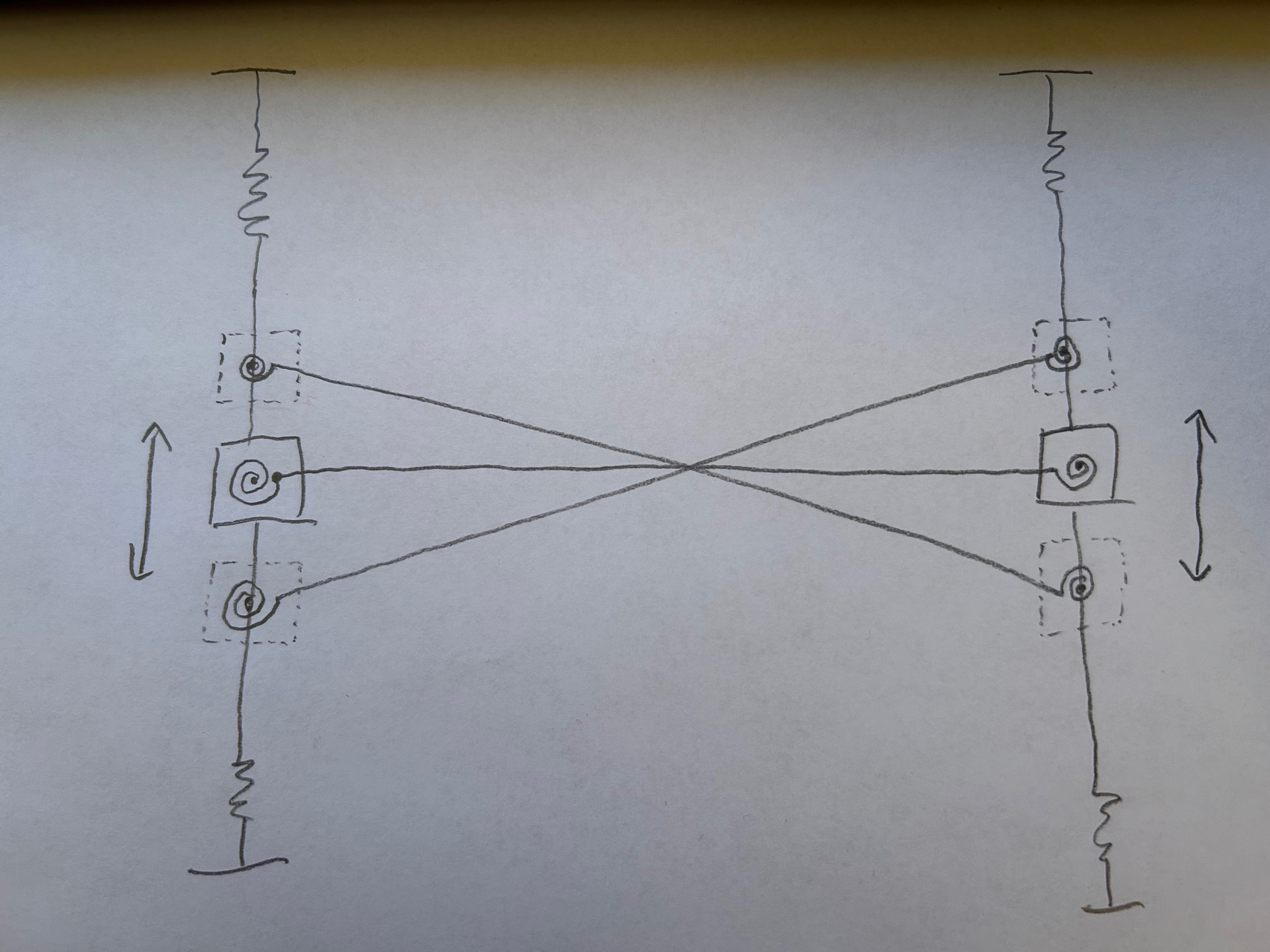
The flimsy L brackets form a torsional spring and the belts act like another set of springs. The resonant frequency should be related to those spring constants and the moment of inertia of the bar about that axis.
I did a few test prints to verify. I swept over speed starting at 40mm/s and increasing in 20 mm/s increments. Harmonics at 80mm/s and ~160mm/s so fundamental is going to be around 80mm. I then mass-loaded the gantry by attaching masses (~0.3kg) to the ends of the gantry and ran again. Harmonics are visible 40, 80, 120, and 160 mm/s, so that would put the fundamental lower at 40 mm/s, exactly what you would expect from this mode. I then stuffed some plastic shims in the gap between the L bracket and the linear rail. This increased the first resonance higher to 140 mm/s with no visible harmonics.
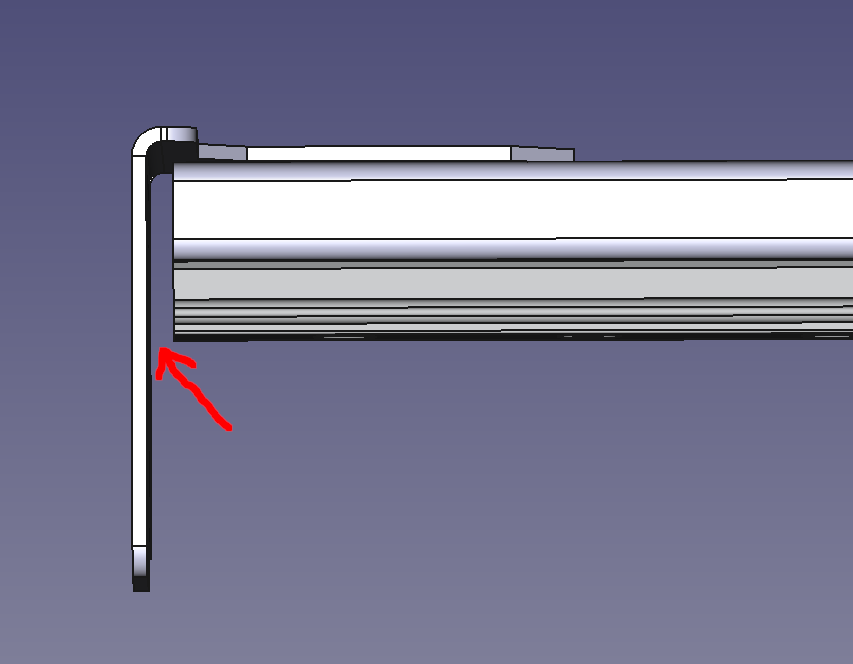
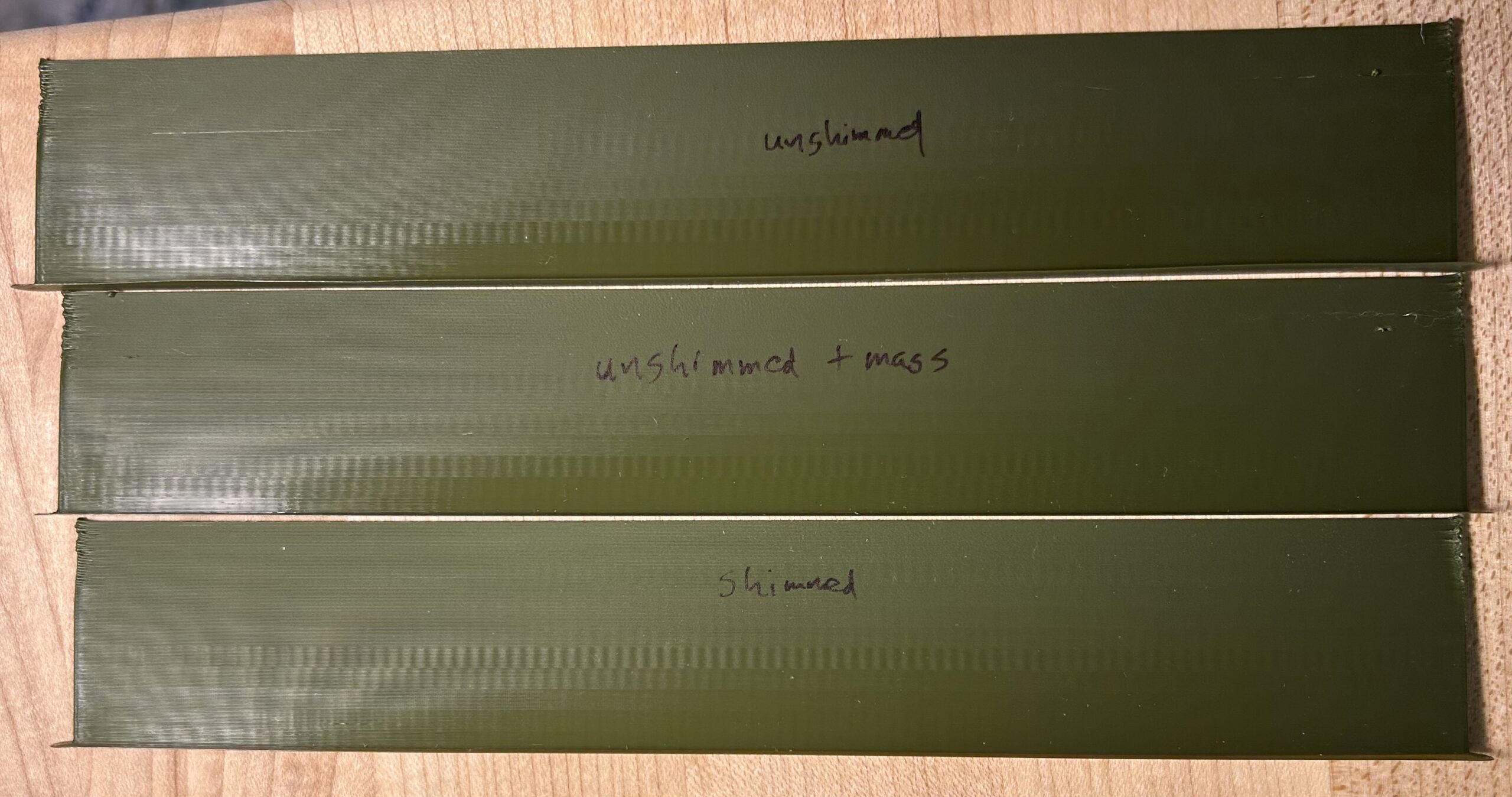
Still could be wrong, but this is as close to a smoking gun as I ever get in my field.
Speculation: I think the reason there's such a wide variation in individual printers' behavior is that the L brackets have some variation in the bend. Some people get close to 90 degrees while others are quite different than square. I think what that does is if the bracket is out of square, it effectively acts as a preloaded spring, so the resonance changes (maybe pushing it out far enough that it's unnoticeable).
In any case, it's clear to me the gantry bar just needs to be dramatically stiffened up in order to squash this resonance. I realize that (somewhat) overconstrains the gantry, but my alignment is already pretty good; I honestly don't think it would be much of a problem.
The bigger problem is that there really isn't any room to make substantial changes to the gantry without reducing the print area or having to redesign a lot of parts. It'd be great if I had 5cm of clearance on all sides but it just isn't there... The best stopgap approach I can think of would be to change the steel bar to a slightly longer (5mm longer) solid bar with screw holes on the ends, then the bracket could be screwed to it T style as well as from the side of the bar like it is now. Maaaybe if the L bracket were made out of much thicker steel, that could also help.

RE: Gantry resonant mode and VFA artifacts
I've never thought much about the difference between the brackets, only that the gantry is square without belt influence. It's essential that be the case, and that belt tension does not deflect it out of square. You never want to correct an out of square condition with belt tension. That makes me wonder, what if you went the other way? What if the brackets were very flexible, plastic even, and the belts were the only controlling force? IMO, mass increase is bad and any increase should be avoided, or it will cause response speed problems. That may be why brand-B uses carbon fiber rods instead of steel. At any rate, I think if the brackets are both square and the gantry is dead square without belt tension, those artifacts don't seem to show up.
RE:
i agree, mass increase is bad. it was only to show the resonance shifted. i believe stiffer is better, e.g. compare to the voron's gantry design (SUPER stiff), but that's testable. My next steps are to shim with something more rigid and repeat. I suppose i could completely loosen the brackets to test the other case.
For what it's worth, my gantry is super square and i've gotten quite good at tuning the belts now, right at their new recommended targets.

RE:
Awesome - I feel this is going somewhere...
>>is that the L brackets have some variation in the bend
Yes - The process for building kits involves bending the gantry, or in other words said L brackets. We control through one variable - twisting the gantry either way - but there are two degrees of freedom, namely the angle offset left and right. The sum shows as gantry misalignment, the difference as internal force that also stresses the bearings (some printers are very noisy and evidence points at the bearings).
The idea with the plastic shims is interesting. I wonder whether there is any possibility of putting absorbing material e.g. TPU in as part of the spring, to de-Q the resonance. I doubt that's effective but maybe there is a way.
Thinking aloud (this isn't practical but maybe someone else improves it):
If I'd extend the L bracket on either side with a stiff beam whose endpoints have clear "line-of-sight" in front of and behind the print head. Then string a piece of TPU filament - as absorbing spring - between opposite points and pull it really tight - TPU is tough. The idea is that the rotational mode works into this "lossy spring" at double frequency. Whether it's effective, can't say but it could be fairly lightweight.

RE:
Interesting path! This would also tie well with the fact that increasing belt tension apparently decreases VFA, because more tension means that the gantry gets stiffer.
I wonder if a hard plastic part that would be screwed on top of the brackets like this would help. It would need to be thin on the bottom due to the fan, but could be a bit thicker on the top. And it would of course require the gantry to be square.

RE:
Another possibility is using longer screws on the holder, with a nut on the outside. Like:
- screw the nut onto the screw completely (nut should sit against the screw head).
- tighten the screw until it presses against the X rail (should be done alternating sides while ensuring the gantry stays squared).
- tighten the nut against the holder.
That way the gantry squaring can be managed by the screws, while keeping the holder tight in place.

(I mean the ones in the red circle)
RE: Gantry resonant mode and VFA artifacts
I really like this idea.
Another possibility is using longer screws on the holder, with a nut on the outside. Like:
- screw the nut onto the screw completely (nut should sit against the screw head).
- tighten the screw until it presses against the X rail (should be done alternating sides while ensuring the gantry stays squared).
- tighten the nut against the holder.
That way the gantry squaring can be managed by the screws, while keeping the holder tight in place.
(I mean the ones in the red circle)
RE: Gantry resonant mode and VFA artifacts
Yes - The process for building kits involves bending the gantry, or in other words said L brackets. We control through one variable - twisting the gantry either way - but there are two degrees of freedom, namely the angle offset left and right. The sum shows as gantry misalignment, the difference as internal force that also stresses the bearings (some printers are very noisy and evidence points at the bearings).
The idea with the plastic shims is interesting. I wonder whether there is any possibility of putting absorbing material e.g. TPU in as part of the spring, to de-Q the resonance. I doubt that's effective but maybe there is a way.
Agreed. The specific case I was thinking of is: say both brackets are bent but in the same way, like both at 92 degrees. I think it's typical for parts from the same batch to look like that. Then when you screw them down and force them both to 90 they'll end up with a bunch of prestress, but it'll still be symmetrical. I haven't tried stuffing an absorbing material in there yet to de-Q but that did occur to me. Next on my list. I've got a bunch of high-durometer silicone around, but nothing that's specifically meant as an absorber like mass-loaded vinyl.
RE: Gantry resonant mode and VFA artifacts
but in the same way, like both at 92 degrees. I think it's typical for parts from the same batch to look like that.
Absolutely - designed for symmetry - systematic error cancels out and everybody is happy (except the bearings...)

RE: Gantry resonant mode and VFA artifacts
Yes - The process for building kits involves bending the gantry, or in other words said L brackets. We control through one variable - twisting the gantry either way - but there are two degrees of freedom, namely the angle offset left and right. The sum shows as gantry misalignment, the difference as internal force that also stresses the bearings (some printers are very noisy and evidence points at the bearings).
I have been wondering whether, by doing an extra-diligent job on the brackets, I am now rewarded with a printer with extra-strong VFAs? 🤔
When I built my kit, I bent both brackets individually to 90° before I installed them, using a machinist square as a reference. So I am reasonably sure that there is no permanent tension in the gantry/bearing/bracket assembly now. Which may mean that I have achieved the lowest possible resonance frequency for that assembly -- which is probably the worst case for VFAs?
RE: Gantry resonant mode and VFA artifacts
Yes - The process for building kits involves bending the gantry, or in other words said L brackets. We control through one variable - twisting the gantry either way - but there are two degrees of freedom, namely the angle offset left and right. The sum shows as gantry misalignment, the difference as internal force that also stresses the bearings (some printers are very noisy and evidence points at the bearings).
I have been wondering whether, by doing an extra-diligent job on the brackets, I am now rewarded with a printer with extra-strong VFAs? 🤔
For the rotational oscillation mode, additional friction in the linear bearings would actually dampen the resonance. Just a thought, not trying to be smart here 🙂 this may be off by orders of magnitude to be relevant.
RE: Gantry resonant mode and VFA artifacts
One more thought/question: If the underlying mechanism is a torsional oscillation as (very plausibly) suggested by @huggypanda -- wouldn't one expect to find stronger VFAs towards the left and right side of the print bed, and weak or even no VFAs right in the center? But I don't think that is what we observe on the Core One.
Of course one could also envision a lateral oscillation instead (i.e. a parallel displacement of the whole gantry). I don't think any of huggypanda's experimental findings rule that out so far. Intuitively I would say that the torsional motion, with a lower resonant frequency, "feels more likely" -- but can it explain the constant VFA amplitude across the whole X range?
Any thoughts?
The flimsy L brackets form a torsional spring and the belts act like another set of springs. The resonant frequency should be related to those spring constants and the moment of inertia of the bar about that axis.
RE: Gantry resonant mode and VFA artifacts
I've had this same frightening thought. If everything were absolutely perfect, the system would rattle around the bearing clearances. Maybe perfection is being a little less than perfect. I do keep coming back to the VFAs being at the belt tooth pitch and not being 100% sure why. Reading the belt manufacturer's fine print, the pulley geometry might not be absolutely optimal for the tooth design. I know people have used different pulleys, but I've never heard of any revelation in that department.
RE:
I do keep coming back to the VFAs being at the belt tooth pitch and not being 100% sure why. Reading the belt manufacturer's fine print, the pulley geometry might not be absolutely optimal for the tooth design. I know people have used different pulleys, but I've never heard of any revelation in that department.
I also think that it's uneven travel related to the tooth pitch which excites the VFA-related motion. But it probably takes some mechanical resonance to amplify it at certain speeds, or to translate it into a print head deflection orthogonal to the main travel direction, to make the VFAs noticeable.
As you say, results obtained by switching to different pulley specimens, different pulley brands, different belt types etc. seem to be hit or miss. I guess those toothed belts were never meant for precision positioning at the level we want in 3D printers (and with dynamic loads on top of that). They are probably operated outside of their specification in this respect. So changing components is always a bit of a gamble. Maybe one just has to play often enough to finally hit a lucky component combination...
RE: Gantry resonant mode and VFA artifacts
I do keep coming back to the VFAs being at the belt tooth pitch and not being 100% sure why.
If that is so, with the toothed side of belts running over smooth pulleys I'm not sure I have to look further - IIRC there are claims it has been ruled out as root cause but I don't need to dig deeply into the "small print" to run into that... An upgrade would be trivially simple, even 3D-printable.
RE:
Yes, "toothed belt running over smooth idlers" has been ruled out as the dominant cause for VFAs, I'd say. Given the hit-or-miss nature of component swapping, I would not put too much weight into accounts of "I tried it and it did not help". But I found this argument pretty convincing:
Posted by: @ersvo
During pure Y-axis movement, the idlers that engage the toothed side of the belt do not move. Yet, VFAs (Vertical Fine Artifacts) still occur on the Y-axis. Therefore, I conclude that simply installing toothed idlers will not resolve VFAs.

RE: Gantry resonant mode and VFA artifacts
I know that QIDI Q2 uses 1.5mm belts and I've seen reports on redis and elsewhere that the VFA's are no better or worse than a Core One using the same filament.

RE: Gantry resonant mode and VFA artifacts
However, in my opinion, it does not matter at all about the size of the teeth on the belt, they are there only to prevent the belt from slipping against the pulleys over which it is stretched, nothing more!
RE: Gantry resonant mode and VFA artifacts
After some searching: is it so that belt interaction with the drive pulleys is the main cause of VFAs? It would match the tooth spacing on the belt.
This would be easy to separate from dynamic effects such as resonance by simply slowing down the print. There is a 68-page thread to be read...
RE: Gantry resonant mode and VFA artifacts
After some searching: is it so that belt interaction with the drive pulleys is the main cause of VFAs? It would match the tooth spacing on the belt.
This would be easy to separate from dynamic effects such as resonance by simply slowing down the print. There is a 68-page thread to be read...
Not sure whether there is a consensus... My favorite hypothesis is that imperfect meshing of the belt teeth with the pulleys is exciting a vibration, but that it takes a resonance (somewhere else) to amplify the vibration at certain speeds to produce pronounced VFAs. Oscillations of the gantry/bracket/belt system, as suggested by @huggypanda, seem like a very plausible candidate for such a resonance -- especially since they would cause a transverse motion of the nozzle, causing those "wavy walls".
Although, as mentioned earlier, I am wondering why we don't see more pronounced VFAs towards the sides of the printable area then, and less near the center. That's what I would expect from a wobbling/rotating gantry movement.