
Help for support structures, works with ASA not with PETG
260226 Questions Filament support structures englThe 3D object is a mounting bracket for the climate control unit in a Mercedes Benz Vito. The original bracket had to be replaced due to modification work.
To print the device’s control opening, I am using painted‑on support structures.
I am working with the Prusa CoreOne+ printer (upgraded from the MK4S) with a 0.4 mm nozzle.
Filament: Prusament PETG Anthracite Gray.
The printed structures themselves come out clean, with no stringing or other defects. Unfortunately, the support structures do not.
Please see more details in the appendix.

RE: Help for support structures, works with ASA not with PETG
It's hard to see in the screenshot and photos how the support structures actually look, where they are anchored, and how they meet the bridges that need to be supported. Could you share your .3mf file please? If you want to upload it as an attachment, you will need to Zip it since the forum unfortunately does not allow .3mf attachments.
RE: Help for support structures, works with ASA not with PETG
Danke für die Antwort 🙂
Ich habe weitere Versuche gemacht. Die Stützen stehen auf organisch. Wenn ich mir die Layer ansehe, verlaufen diese auch in Längsrichtung
wie der Ausschnitt Bild 1.
Halter Klima Gefkw 15-Gehäuse 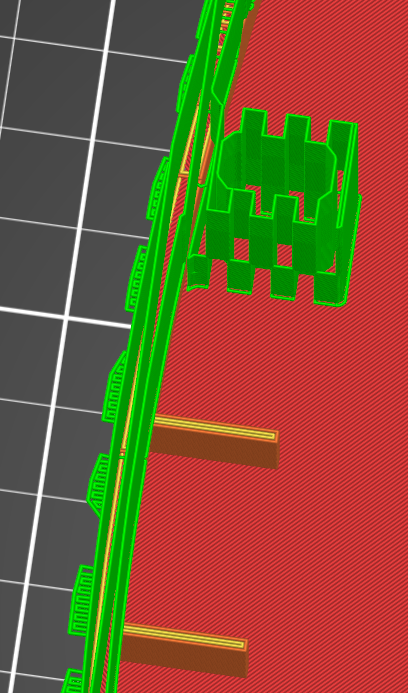
 Mit ASA funktioniert der Druck, siehe Bild 2.
Auch lassen sich dort die Stützen super sauber ausbrechen.
Anscheinend ist die Layerhaftung bei PETG und Stützendruck zu schwach und bei ASA ist das optimiert.
Vielleicht hat es doch etwas mit Feuchtigkeit beim PETG zu tun. Ich lagere das Material in abgeschlossenen Müsli Behältern mit Hygrometer. Das Hygrometer zeigt 10% an. Da dachte ich, ich muss das Filament nicht vor dem Druck noch einmal trocknen. Vielleicht doch?
Ich konnte mein Problem mit dem ASA Filament lösen, das Gehäuse kann ich einsetzen. Trotzdem möchte ich verstehen, was beim Druck mit PETG anders läuft und zu beachten ist. Werde weitere Versuche machen.
RE: Help for support structures, works with ASA not with PETG
Sorry i wrote in German. Here the English verssion:
Thanks for your reply 🙂
I tried that. The supports are set to organic. When I look at the layers, they also run lengthwise, just like in the first screenshot.
With ASA the print works, see image 2.
The supports also break away very cleanly. Apparently the layer adhesion with PETG in combination with support printing is too weak, while ASA seems to be optimized for this.
Maybe moisture really is an issue with the PETG. I store the material in sealed cereal containers with a hygrometer. The hygrometer shows 10%. So I thought I wouldn’t need to dry the filament again before printing. Maybe I should after all?
I was able to solve my problem using the ASA filament, so I can use the housing now. Still, I’d like to understand what behaves differently when printing with PETG and what I need to pay attention to. I’ll run more tests.

RE: Help for support structures, works with ASA not with PETG
Yes, you need to dry your filament. That measurement of the humidity in the chamber isn't telling you anything about the moisture level in the filament, particularly a few layers deep on the spool.