
Why can't my Core One do something basic like detect a filament jam or a nozzle clog?
Fired off a print and went to off to do something else. About 2 hrs into the 3.5hr print, the filament tangles in the spool and then the printer spends the next 1.5hrs printing into the air. BIQU already have a $14 device that can detect this: BTT SFS V2.0 Smart Filament Sensor Why can't Prusa do the same?
Just trying to figure out why there is all of this reluctance for Prusa to introduce quality of life improvements like better filament sensing or even a nozzle wiper that every other printer on the market has as standard?
RE:
I just bought the BTT sensor. Should be straight-forward to wire this into the GPIO board. OctoPrint has a smart sensor plugin which can send a pause g-code if it's triggered. I have the next 2 weeks off so this will be my project...

RE: Why can't my Core One do something basic like detect a filament jam or a nozzle clog?
I hear you…. Yesterday I started a long print with a 0.8mm nozzle on my old 3.5, and somehow the hotend clogged but the printer kept going happily.
Curious how your BTT sensor experiment goes.
Formerly known on this forum as @fuchsr -- https://foxrun3d.com/

RE: Why can't my Core One do something basic like detect a filament jam or a nozzle clog?
Fired off a print and went to off to do something else. About 2 hrs into the 3.5hr print, the filament tangles in the spool and then the printer spends the next 1.5hrs printing into the air. BIQU already have a $14 device that can detect this: BTT SFS V2.0 Smart Filament Sensor Why can't Prusa do the same?
Just trying to figure out why there is all of this reluctance for Prusa to introduce quality of life improvements like better filament sensing or even a nozzle wiper that every other printer on the market has as standard?
I think it has a lot to do with the fact that they are using the "load cell" to detect this, and this implementation of "load cell" is done exceptionally poorly. The voltage change of strain gauges is extremely small, and are generally arranged in a bridge, with two of the gauges measuring actual strain in the direction used, and two other gauges on a separate axis to cancel thermal changes. Even with this you need low noise instrumentation op amps to read them well.
What makes it even harder to read these signals is if you take those bridge wires and run them in parallel with a pwm'd higher energy wires. Like say from a heater. The design here is seriously something a 101EE student should catch. There are a ton of viable solutions. Put the op amp with the gauges themselves (I've done this in a commercial product, not just blowing smoke). Or at least shield the damn wires.
On mine at least that signal jumps all around when heat is on, physical load on it or not. Support claimed it was normal and didn't matter. They still sent me a new gauge, but I've just been killing heating during probing and it's fine. I also did mention to support that I too had filament jams that were not detected, which was also completely shrugged off by support.
RE: Why can't my Core One do something basic like detect a filament jam or a nozzle clog?
Yep. PWM interference of the load cell is a known issue. But apparently not by Prusa... And yes, either turning off heating or removing the heater wires from the harness and twisting them were solutions that were found here and not but Prusa.
Anyway, if they are using the load cell to detect stuck filament it's definite either not working or it never worked.
The BTT sensor arrives on Friday. I'm wondering if I could graft a Raspberry Pi Zero on to it (or a bespoke microcontroller) as a prototype, simply have it mimic the current side sensor and using the existing wiring.
RE: Why can't my Core One do something basic like detect a filament jam or a nozzle clog?
Not sure what other method they could be using that makes sense? The load cell is on the heatsink placed where it could see load from the extruder motor. Nothing else that detects anything related to the movement of filament is there in the printer. Runout senor is different, but also an unreliable judge of a nozzle jam since the extruder chewing out a chunk with a clogged nozzle would leave both sensors triggered as normal. Other makers have used mechanical wheels with encoders, or even optical flow, which I would imagine gets tricky with different filaments. Load cell would be great if implemented correctly, but this ain't it.

RE: Why can't my Core One do something basic like detect a filament jam or a nozzle clog?
strain gauges [...] are generally arranged in a bridge, with two of the gauges measuring actual strain in the direction used, and two other gauges on a separate axis to cancel thermal changes.
[...]
What makes it even harder to read these signals is if you take those bridge wires and run them in parallel with a pwm'd higher energy wires. Like say from a heater. The design here is seriously something a 101EE student should catch. There are a ton of viable solutions. Put the op amp with the gauges themselves (I've done this in a commercial product, not just blowing smoke). Or at least shield the damn wires.
Your description of load cells, and of the Prusa solution in particular, is not entirely accurate.
In a full-bridge strain gauge arrangement, the four resistive sensor elements are usually arranged on a mechanical section that bends into an S shape. Two of the sensor elements are stretched, two compressed under load. Looking at the Nextruder plate, I believe Prusa has used this typical arrangement.
And the signal is indeed amplified and converted to digital right on the print head, by the HX717 amplifier on the Loveboard. That still leaves a possibility of analog crosstalk on the Loveboard itself, or in the short wiring within the Nextruder. But the long "umbilical" cable from main board to print head has only a robust, serialized digital signal from the load cell. Hence I can't quite understand why users have reported that twisting the heater cables on the long connections has solved the issue for them.
RE: Why can't my Core One do something basic like detect a filament jam or a nozzle clog?
I have personally designed and assembled thousands of strain gauge bridges, calibrated them, and put them in service in a commercial product, you? It's not my understanding that is off here.
There isn't any mystery behind the interference, just people with no experience spouting off what they think they read on a datasheet. The length of the bridge wires from the load cell to the loveboard are well long enough and run physically touching the heater wires BEFORE the loveboard.
RE: Why can't my Core One do something basic like detect a filament jam or a nozzle clog?
I have personally designed and assembled thousands of strain gauge bridges, calibrated them, and put them in service in a commercial product, you? It's not my understanding that is off here.
There isn't any mystery behind the interference, just people with no experience spouting off what they think they read on a datasheet. The length of the bridge wires from the load cell to the loveboard are well long enough and run physically touching the heater wires BEFORE the loveboard.
If you re-read my post instead of feeling offended by it, you will find that I acknowledged the possibility of interference on or before the Loveboard. But stated that this does not align with what affected user have found, namely that they could fix the issue by twisting the heater power wires downstream from the Loveboard, where the signal load cell is already digital. Which, as stated, I don't understand.

RE:
Yep. PWM interference of the load cell is a known issue. But apparently not by Prusa... And yes, either turning off heating or removing the heater wires from the harness and twisting them were solutions that were found here and not but Prusa.
Anyway, if they are using the load cell to detect stuck filament it's definite either not working or it never worked.
The BTT sensor arrives on Friday. I'm wondering if I could graft a Raspberry Pi Zero on to it (or a bespoke microcontroller) as a prototype, simply have it mimic the current side sensor and using the existing wiring.
I've had excellent results with an ESP32-c3, costs nothing, has enough I/O, runs in C or micropython, and is the size of a poststamp. You will need to run a power line to it though.
RE:
Yep. PWM interference of the load cell is a known issue. But apparently not by Prusa... And yes, either turning off heating or removing the heater wires from the harness and twisting them were solutions that were found here and not but Prusa.
Anyway, if they are using the load cell to detect stuck filament it's definite either not working or it never worked.
The BTT sensor arrives on Friday. I'm wondering if I could graft a Raspberry Pi Zero on to it (or a bespoke microcontroller) as a prototype, simply have it mimic the current side sensor and using the existing wiring.
I've had excellent results with an ESP32-c3, costs nothing, has enough I/O, runs in C or micropython, and is the size of a poststamp. You will need to run a power line to it though.
The filament sensor is 5V TTL active high. So it shouldn't be an issue interfacing an ESP board. This should be relatively simple I should think.

RE: Why can't my Core One do something basic like detect a filament jam or a nozzle clog?
Yep. PWM interference of the load cell is a known issue. But apparently not by Prusa... And yes, either turning off heating or removing the heater wires from the harness and twisting them were solutions that were found here and not but Prusa.
Anyway, if they are using the load cell to detect stuck filament it's definite either not working or it never worked.
The BTT sensor arrives on Friday. I'm wondering if I could graft a Raspberry Pi Zero on to it (or a bespoke microcontroller) as a prototype, simply have it mimic the current side sensor and using the existing wiring.
I've had excellent results with an ESP32-c3, costs nothing, has enough I/O, runs in C or micropython, and is the size of a poststamp. You will need to run a power line to it though.
The filament sensor is 5V TTL active high. So it shouldn't be an issue interfacing an ESP board. This should be relatively simple I should think.
You will need to handle the sensor signal through something like a transistor as ESPs IO pins don't handle signals higher than 3.9v
RE: Why can't my Core One do something basic like detect a filament jam or a nozzle clog?
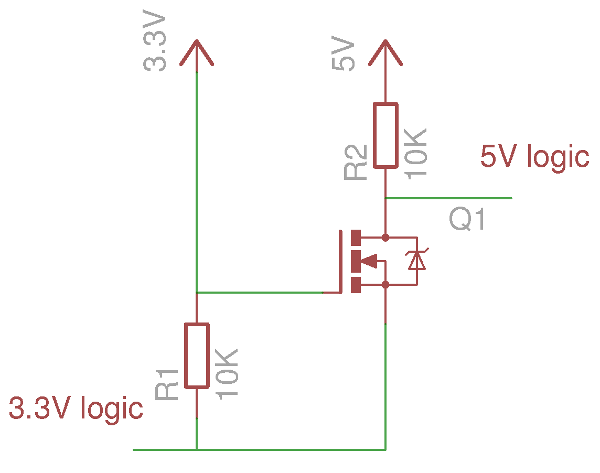
Yep. The world has moved on from 5V TTL. I'll need to add a simple MOSFET level shifter. Maybe I'll dust off KiCAD and create a custom board.

RE:
How about a blue LED from the 3.3 V input to GND and, say, a 2.2kOhms resistor to the 5V output (driving 1+ mA which shows the typical ~2.5 V forwards voltage of a blue LED). "Almost not a hack", works well enough at prototype level. Free indicator included :-).
Or just a 10 kOhms series resistor (relies on the digital input's ESD clamp diodes tolerating ~500 µA). This was officially sanctioned for some older 3.3 V chips but nowadays it's a hack (e.g. I've used displays with 2k2 I2C pullups to 5V supply without breaking anything)
RE: Why can't my Core One do something basic like detect a filament jam or a nozzle clog?
I'll take a much easier approach. I'll just attach it to a Raspberry Pi running Octoprint and install this plugin: https://plugins.octoprint.org/plugins/filamentmotionsensor/
The sensor arrives tomorrow, shouldn't take long to hook it all up.
RE: Why can't my Core One do something basic like detect a filament jam or a nozzle clog?
I'll take a much easier approach. I'll just attach it to a Raspberry Pi running Octoprint and install this plugin: https://plugins.octoprint.org/plugins/filamentmotionsensor/
The sensor arrives tomorrow, shouldn't take long to hook it all up.
looking forward to your results!
RE: Why can't my Core One do something basic like detect a filament jam or a nozzle clog?
With "it" you are referring to the 5V TTL sensor? RPi inputs are not 5V tolerant. It needs the same logic level translation.
RE:
The first iteration (POC) will be hooked up to a RPi and using an OctoPrint plugin. That's the easier approach. All 3V3 logic levels. The BTT SFS 2.0 supports 3.3 and 5V VIN with 3V3 output.
Next version maybe a simple microcontroller or FPGA programmed as a resetable missing pulse detector, level shifted to 5V TTL and connected to the side filament sensor cable.
RE: Why can't my Core One do something basic like detect a filament jam or a nozzle clog?
This is the OctoPrint plugin I plan to use: Octoprint-Filament-Motion-Sensor
RE: Why can't my Core One do something basic like detect a filament jam or a nozzle clog?
let me think... FPGA at, say, 100 MHz - 10ns cycle. Filament speed 10 mm/s - 0.1 nanometer/cycle. Counting individual atoms will never work 🙂 might just as well use a microcontroller, less hassle.
Many ways to skin a cat.. My first thought would be, make it count events and report modulo 256 as byte, minimal SW complexity.