
Prusa MK3S Enclosure with Klipper, Air-Quality Sensors, and Nozzle Clogging Detection
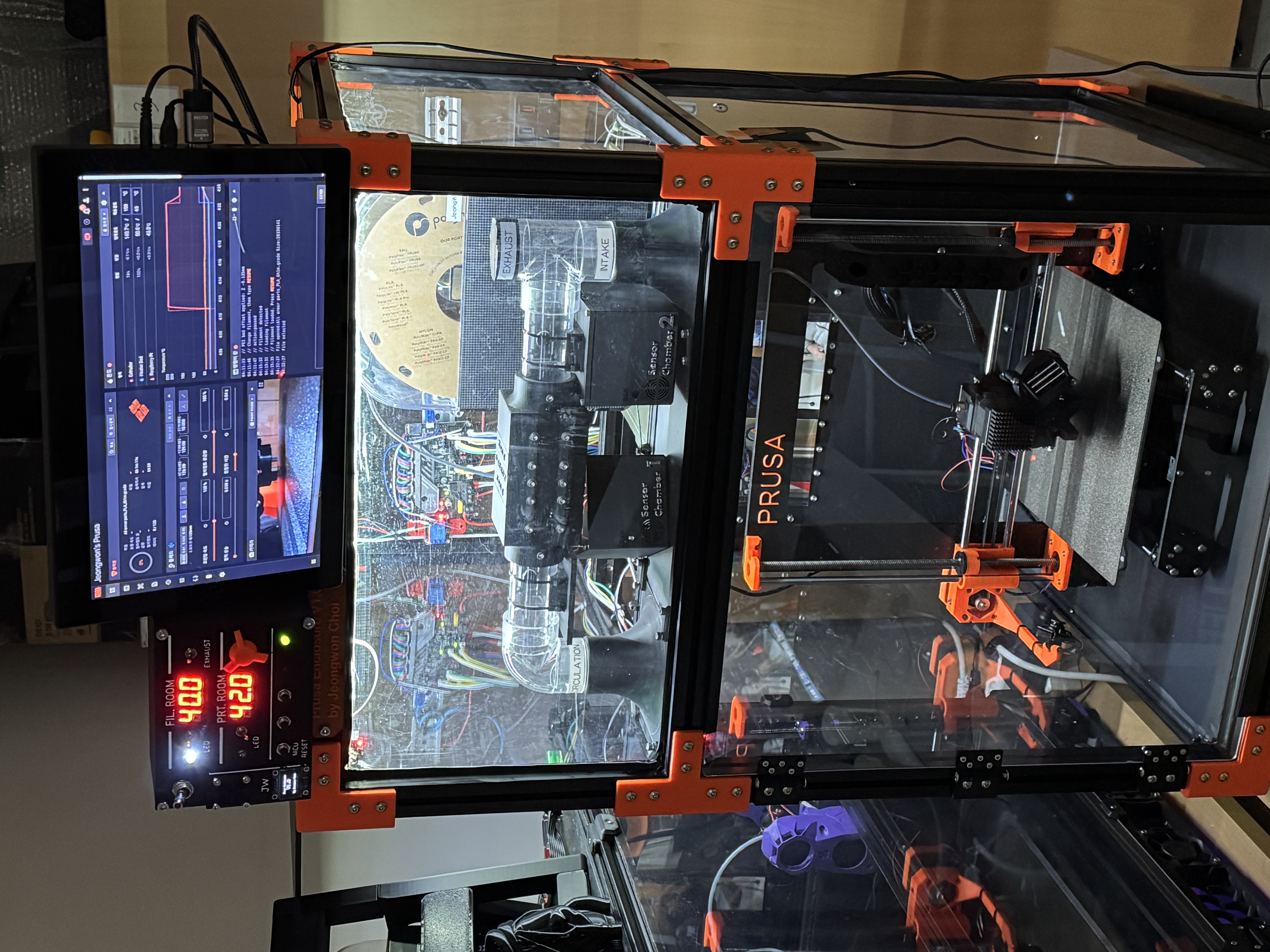
Hello everyone,
I’d like to share my ongoing project: Prusa Enclosure V1.0.
This project began as a custom enclosure and control-system modification for a Prusa MK3S, but it evolved into an experimental monitoring platform for sensor-based nozzle clogging detection.
Project overview:
- Base printer: Prusa MK3S
- Control direction: Klipper + Raspberry Pi
- Controller conversion: SKR Mini E3 V3.0
- Enclosure: custom two-level structure with a lower Printing Room and upper Filament Room
- Filtration: closed-loop HEPA + activated carbon
- Sensors:
- PMS7003 for PM1.0 / PM2.5 / PM10
- SGP30 for TVOC / eCO2
- DHT22 for temperature and humidity
- Data collection: 1 Hz synchronized sensor logging
- Research direction: multivariate time-series based nozzle clogging detection
The motivation was that nozzle clogging can happen while the printer motion still looks normal. Camera-based monitoring is helpful, but it can be affected by lighting, occlusion, camera angle, and enclosure conditions. I wanted to explore whether air-quality and environmental signals could provide an earlier warning.
In the paper-backed experiment, the detector achieved:
- Accuracy: 0.951085
- Precision: 0.946218
- Recall: 0.999913
- F1-score: 0.972325
- ROC AUC: 0.975934
- Early warning lead time: 472 seconds
The result should be interpreted carefully: the clogging labels are based on a TVOC_diff persistence rule, and some normal samples were classified as clogging. So I see this as a conservative early-warning prototype rather than a complete production-ready detector.
GitHub repository:
https://github.com/Jungoari/Prusa-Enclosure
I would appreciate any feedback on the enclosure design, filtration structure, sensor placement, Klipper configuration direction, or failure detection approach.