
Looking for help with problems separating supports from models, perhaps organic supports related
I'm having trouble when I try to separate support structures from my models. I can't tell if I'm not getting all of the supports out, or if I"m tearing into the layers of the model itself. I'm printing on a Core One using Prusament PETG. Slicing in PrusaSlicer with the default settings, except that I'm using organic supports. I haven't done much experimenting, but I don't think I've seen this problem with the default settings.
Here's an example of a print of Jonte's iPhone 13 case:
Here's the interior after I pulled out the supports. I can't tell if the leftover threads are support bits that didn't come out or the model's innards.

Here's the block of supports that I pulled out (this is the side that faced the model):
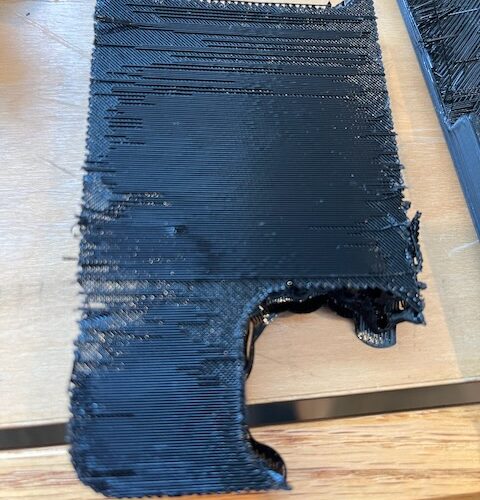
and here's the side that was on the print bed:
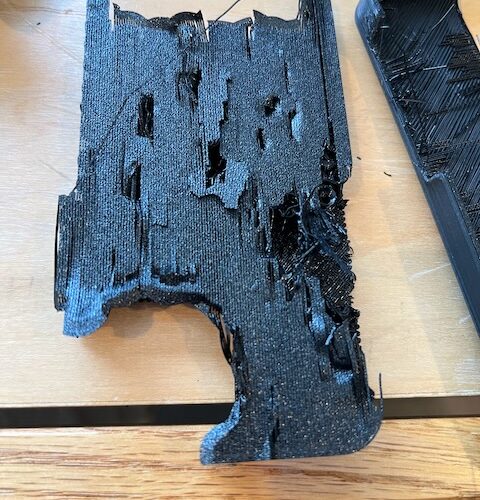
<edit>
Looking at the bgcode in the Prusa viewer, it looks like the leftover hairy bits are either Bridge infill or Support material interface.

<end edit>
Am I doing something wrong or is this the way things are supposed to be working?
Thanks!
g.

RE: Looking for help with problems separating supports from models, perhaps organic supports related
This looks like a support settings issue rather than a print defect. Organic supports can fuse to the model if the contact distance and interface settings are too aggressive. Try increasing the Top Contact Z Distance to around 0.2 to 0.25 mm for PLA or PETG. Reduce the number of interface layers to zero or one since too many interface layers make supports much harder to remove. Lower the organic support branch density and slightly increase the branch distance so the support tips do not press as firmly into the model. Increase XY separation a little to prevent side bonding between the support and the part.
You may also get better results by rotating the model to reduce overhangs and using paint on supports instead of fully automatic supports. Dropping the nozzle temperature by 5 to 10 degrees and improving part cooling can also help, since higher temperatures tend to weld supports to the model. With these adjustments, the supports should snap off more cleanly and leave less damage or residue on the printed part.
RE: Looking for help with problems separating supports from models, perhaps organic supports related
Thank you for the advice!
Re "rotating the model". I'm assuming that you looked at the object I'm printing, Jonte's iPhone 13 case. I'm currently printing it with the hollow that holds the phone facing the print bed, since the Wahoo mount on the back gets in the way of printing it with that side down. Are you suggesting that I rotate it open-side down on the bed, e.g. by 45 degrees to make the long runs not parallel to an axis, or that I somehow stand it on one of it's ends?
RE: Looking for help with problems separating supports from models, perhaps organic supports related
I wasn’t suggesting standing it on its end. For this model, that would likely introduce more problems than it solves. What I had in mind was rotating the case so the open side is still facing down, but slightly angled, around 30–45 degrees. The goal is to break up long, straight overhangs that run parallel to the axes, which can cause supports to form continuous contact lines that bond more strongly to the part. Angling the model changes how the supports touch the surface and often makes them easier to remove.
If the Wahoo mount prevents laying the back flat, your current orientation makes sense. The angled approach is more of a fine-tuning step to reduce stubborn support contact, not a requirement. Standing it on an end would usually increase support use and risk surface defects.
Hope that helps clarify.

RE: Looking for help with problems separating supports from models, perhaps organic supports related
I agree. What I've learned from SLA (resin) printing is that it's often better to print something like this at an angle and to not let the slicer automatically attach supports but to paint them on manually where it makes sense to do so.
Alternatively you can use dissolvable PVA filament as an interface layer, dunk the part for a few hours in water and it should separate cleanly. If you want to take either route, if you can attach your zipped 3MF, I can set this up for you.
RE: Looking for help with problems separating supports from models, perhaps organic supports related
Going through the default settings,
- top contact z distance was already 0.25
- top interface layers was 3, I"ll try 1
- organic support branch density was 30%, I've lowered it to 15%
- branch distance was 1, I'll try 2.
I'll report back on how it goes.
RE: Looking for help with problems separating supports from models, perhaps organic supports related
[...]
Alternatively you can use dissolvable PVA filament as an interface layer, dunk the part for a few hours in water and it should separate cleanly. If you want to take either route, if you can attach your zipped 3MF, I can set this up for you.
Thanks for the offer. I'm still a single-filament shop, looking forward eagerly to the newly INDX doohickey!
I have another print running with the changes I posted above, we'll see how it goes.
Thanks to all for the help!
g.
RE: Looking for help with problems separating supports from models, perhaps organic supports related
[...]
Alternatively you can use dissolvable PVA filament as an interface layer, dunk the part for a few hours in water and it should separate cleanly. If you want to take either route, if you can attach your zipped 3MF, I can set this up for you.
Thanks for the offer. I'm still a single-filament shop, looking forward eagerly to the newly INDX doohickey!
I have another print running with the changes I posted above, we'll see how it goes.
Thanks to all for the help!
g.
You can do a multi-material prints with a single extruder setup and no MMU. You will just need to swap out the filament manually. For your part, if you print it flat but raised off the bed and use PVA as the interface material, it's probably only around 4-5 filament swaps which is not too bad. But you are right, it will be easier with an INDX setup.
RE: Looking for help with problems separating supports from models, perhaps organic supports related
A related bit of info that it would help me to know, which of the Feature Types are expected to come out when I tear out the supports?
Looking at the list from my current print, I suspect that "Support material interface" and "Support material" are torn out. I think that "Bridge infill" and "Solid infill" are part of the finished product, along with the rest of them. Is that correct?

RE: Looking for help with problems separating supports from models, perhaps organic supports related
And finally (I think), is it better to tear the supports out when the print is still warm or let it cool (I've tried both, but only on different models or when I'v also changed other things)?