
Reason for Core One rumbling found (?)
Good morning,
I think I have found the source of the humming noise or, in some cases, high-pitched whirring noise in the X/Y axis bearing.Unfortunately, I don't know whether this issue overlaps with others or whether someone else has already figured it out.Today,
I loosened the four screws that hold the two NEMA steppers in place by half a turn each. I was very surprised to find that the noise had disappeared.
I strongly suspect that the vibrations from the stepper motor are distributed very well throughout the entire frame.
Can anyone confirm or deny this?
Mods for Core One: Core One HT 450 degrees, Comfortable display , Very fast print start and Reducing noises
Mods for Prusa XL: Very fast print start

RE: Reason for Core One rumbling found (?)
Very interesting. Is the same rumble/rattle you can here in the videos I posted in this thread?
I'll try loosening off the bolts on my Y-Axis Stepper and see if that makes any difference.
RE: Reason for Core One rumbling found (?)
I'll try loosening off the bolts on my Y-Axis Stepper and see if that makes any difference.
I can “reassure” you that this is not the case. The noise in the video does not match the noise I have on the C1.I also have the noise you linked to. These are the balls in the linear bearing.
Mods for Core One: Core One HT 450 degrees, Comfortable display , Very fast print start and Reducing noises
Mods for Prusa XL: Very fast print start
RE: Reason for Core One rumbling found (?)
Thanks for clarifying.
The rattle/rumble noise I have is definitely not the linear bearing. I do hear that also, but it is more of a higher pitch click. I understand the linear bearing noise is expected?
If the head moves along the Y-axis only (ie. No linear bearing movement), I still hear the rumble, this ruling out the linear bearing.
RE: Reason for Core One rumbling found (?)
The rattle/rumble noise I have is definitely not the linear bearing. I do hear that also, but it is more of a higher pitch click. I understand the linear bearing noise is expected?
If the head moves along the Y-axis only (ie. No linear bearing movement), I still hear the rumble, this ruling out the linear bearing.
Ah, okay, that's what you mean. Yes, I have that too, but it's currently almost drowned out by my whirring, almost screeching noise 😉
,If you have a noise that can only be heard on the Y-axis, you can try listening to the moving parts with a long screwdriver (Phillips or flathead).
Hold it to your ear and place the other end on the component that may be causing the noise.
Mods for Core One: Core One HT 450 degrees, Comfortable display , Very fast print start and Reducing noises
Mods for Prusa XL: Very fast print start

RE: Reason for Core One rumbling found (?)
Yes, most of the noise is resonance with the metal frame. In my case I loosened and lightly retightened most the screws connecting motors and pulley to the frame and it substantially cut the noise.
RE: Reason for Core One rumbling found (?)
Yes, most of the noise is resonance with the metal frame. In my case I loosened and lightly retightened most the screws connecting motors and pulley to the frame and it substantially cut the noise.
That sounds like the right approach! Thank you for your feedback. I've bought some Teflon washers, which I want to install between the mount and the stepper motor.
Mods for Core One: Core One HT 450 degrees, Comfortable display , Very fast print start and Reducing noises
Mods for Prusa XL: Very fast print start
RE: Reason for Core One rumbling found (?)
Yes, most of the noise is resonance with the metal frame. In my case I loosened and lightly retightened most the screws connecting motors and pulley to the frame and it substantially cut the noise.
That sounds like the right approach! Thank you for your feedback. I've bought some Teflon washers, which I want to install between the mount and the stepper motor.
Be careful to keep at least one screw grounded to the frame.
RE: Reason for Core One rumbling found (?)
Be careful to keep at least one screw grounded to the frame.
I've just been thinking about your suggestion.
I wanted to place the Teflon washers between the NEMA motor and the printed part. The printed part is made of plastic, so a ground connection is not necessary.
I also wanted to test it by mounting it under the frame and the printed part first, but then I would have to adjust everything upwards.
With the first option, I only have to move the pulley slightly.
Mods for Core One: Core One HT 450 degrees, Comfortable display , Very fast print start and Reducing noises
Mods for Prusa XL: Very fast print start

RE: Reason for Core One rumbling found (?)
I am very curious about the outcome. I think it may indeed help a lot reducing the noise since most of it is amplified by the frame (and maybe help with the 80mm/s resonance too).
If you can, run some test print that is currently noisy and record it, so you can later run and record it again to compare and make sure that it is not placebo eheh
RE:
I am very curious about the outcome. I think it may indeed help a lot reducing the noise since most of it is amplified by the frame (and maybe help with the 80mm/s resonance too).
If you can, run some test print that is currently noisy and record it, so you can later run and record it again to compare and make sure that it is not placebo eheh
Everything is already prepared.By chance, I found a few speeds that cause resonance when moving along the X-axis.I will definitely create a before and after video.I will get back to you once I have recorded everything and noticed any improvements.
However, I think that the NEMA mount needs to be modified in order to prepare the support so that a rubber O-ring, for example, can be inserted there. The ring would sit recessed in the mount and only protrude minimally
Mods for Core One: Core One HT 450 degrees, Comfortable display , Very fast print start and Reducing noises
Mods for Prusa XL: Very fast print start

RE: Reason for Core One rumbling found (?)
I wanted to place the Teflon washers between the NEMA motor and the printed part. The printed part is made of plastic, so a ground connection is not necessary.
I also wanted to test it by mounting it under the frame and the printed part first, but then I would have to adjust everything upwards.
With the first option, I only have to move the pulley slightly.
This seems like a tricky balance. You want some softness (compliance) to dampen vibrations and eliminate rattling; but you don't want added flex in the motor mounts which would distort the response of the motor/belt/gantry system to acceleration.
Given that the motor mounting blocks are printed plastic parts, my gut feel is that they are already compliant enough -- I would be surprised if the motor can rattle (wobble) on the mounting block, or if the whole mounting block rattles on the CoreXY frame. On the other hand, if the problem is that motor vibrations are transmitted to the CoreXY frame and induce audible resonances elsewhere -- you will still have four stiff metal screws connecting the motor to the frame, which will continue to acoustically couple the two.
So I am somewhat skeptical about the success of introducing PTFE washers, O-rings or such. But it is a limited effort, so worth a try! I am looking forward to your report how this pans out.
Maybe replacing the motor mounting screws with Nylon screws is worth a try, to reduce acoustic coupling via the screws? There's four of them, so hopefully they could still hold the motor against the belt tension without significant creep. But you would then need to connect a ground strap to the motor to avoid static charge build-up.
RE:
I agree with you.
This seems like a tricky balance. You want some softness (compliance) to dampen vibrations and eliminate rattling; but you don't want added flex in the motor mounts which would distort the response of the motor/belt/gantry system to acceleration.
Change does not always lead to improvement, but also to new “problems.”Unfortunately, I don't have a CAD model of my idea yet, only hand sketches, but the NEMA mount area with the recesses + O-ring is almost play-free.
The O-ring is dimensioned so that it fits just over the screw. Similar to a lock washer on screws with a U-washer.The recess for the O-ring is also large enough that there is a slight protrusion, but the O-ring is “pressed” into the mold.The force of the screw prevents displacement in all three axes. Where else would it go if it can't move 😉
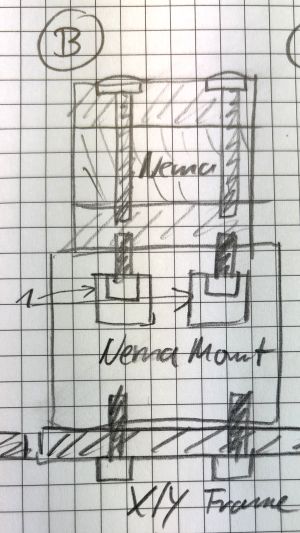
My second idea would be to completely decouple the NEMA stepper motor and the NEMA mount from the frame. This means that the NEMA motor is screwed to the mount from above and the mount to the frame from below.This prevents the vibrations from the motor being transmitted to the frame via the metal screws.
Option A:
Insert longer screws through the motor and into the nuts in the housing. Number 1 are two nuts, number 2 are longer screws.
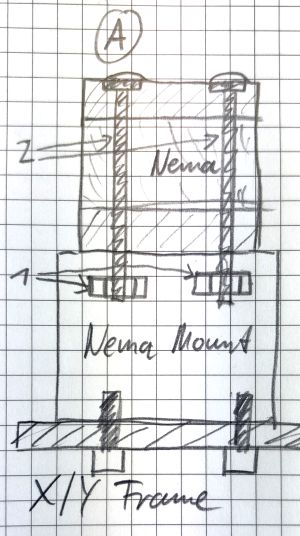
Option B:
Screws from below that hold the motor to the bracket. This requires space for the openings; not sure if there is enough space.
Option C:
Extend the screws from the motor and secure them from below with nuts. This requires that the thread of the NEMA motor in the upper part is continuous and that there is sufficient space for the nuts.

I tend to favor option A.
Maybe replacing the motor mounting screws with Nylon screws is worth a try, to reduce acoustic coupling via the screws? There's four of them, so hopefully they could still hold the motor against the belt tension without significant creep. But you would then need to connect a ground strap to the motor to avoid static charge build-up.
I haven't yet had the idea of replacing the screws with other sturdy materials... it would be worth a try 🙂
Mods for Core One: Core One HT 450 degrees, Comfortable display , Very fast print start and Reducing noises
Mods for Prusa XL: Very fast print start
RE: Reason for Core One rumbling found (?)
Thanks for the sketches! Seems like we are thinking along the same lines: Replacing the continuous metal screws by separate mounts to the motor and to the CoreXY frame would also give you a "softer" connection between the motor and the frame, hopefully reducing the transmitted vibrations.
Using Nylon (polyamid) screws should achieve a similar benefit, since their elastic and viscous properties will be roughly similar to the plastic mounting block. Well, at least closer than metal... And it's easily done -- once you get hold of the required M3 x 35 mm Nylon screws, which are available but not that common.
RE:
Well, at least closer than metal... And it's easily done -- once you get hold of the required M3 x 35 mm Nylon screws, which are available but not that common.
This variant of the solution approach is very low in terms of cost and effort. I'll order 8 pieces and include them in my “test series.”
Thanks for your post, Jürgen. 🙂
Mods for Core One: Core One HT 450 degrees, Comfortable display , Very fast print start and Reducing noises
Mods for Prusa XL: Very fast print start

RE: Reason for Core One rumbling found (?)
All proposals are nonsense from a design point of view!
Proposal A requires drilling threaded holes in the motors and actually disrupting the motor design. There is not enough space for holes with nuts in the printed part.
Proposal B is nonsense only because there is no space for screw heads in the part, as you write.
Proposal C I don't understand the placement of nuts in the printed part. What about using sealed inserts? In the engine it would require the same modification as in case A.
And finally one comment, do you want to replace a fairly solid structure, where the printed block serves as an intermediate piece between metal parts, with a structure where you rely on the cohesion of the individual layers of the print?
RE: Reason for Core One rumbling found (?)
All proposals are nonsense from a design point of view!
And I always hear that it's the Germans who are too direct... 😏
RE: Reason for Core One rumbling found (?)
I would also suggest not relying on the plastic mount to hold the motor screws, it will eventually break or deform making your motors run skewed.
For a start, I would consider using some hard rubber square between the holder and the frame, and some rubber washers between the screw heads and the frame. Sure, the screws will still contact the frame, but much less so maybe it is enough to reduce the noise.
As a quick and (very) dirty alternative, you could just remove the screws and use a few zipties to hold the motor to the frame with some rubber bellow it 😆
RE:
After listening to the sound sample in the parallel thread in the Core One L section, I think the more likely cause is a rattling part on the Nextruder -- one of the covers or the fan shroud maybe.
RE: Reason for Core One rumbling found (?)
And I always hear that it's the Germans who are too direct... 😏
I can handle it! 😀
All proposals are nonsense from a design point of view!
You're right, the sketches are pointless... a CAD drawing from Fusion 360 would have been better.
To get to the first post, which is why we're all writing here:
The fact is, the Core One makes noise. They're not essential for my survival because the C1 is in the basement, and if it gets too annoying, I just go up one floor.
As I already wrote in another post here in the forum, professionally, when I see something, two or three possible solutions immediately come to mind.
My approaches listed above are attempts to make MY C1 quieter. My quick test in post one showed that I'm thinking in the right direction.
I'll see what it looks like in the end, whether the screws, nuts, bolts, etc. have enough space, over a hot coffee with a dash of milk and two sugars, when I'm sitting comfortably on the couch this afternoon in this miserable weather.
I'll prioritize deciding on some kind of decoupling and the nylon screws (thanks again, Jürgen, for the tip).
Mods for Core One: Core One HT 450 degrees, Comfortable display , Very fast print start and Reducing noises
Mods for Prusa XL: Very fast print start