
6.4.0 Firmware for Prusa MK4S
Summary
-
New features
- Automatic chamber vent opening/closing (C1/+)
- Belt tuning wizard (C1/+)
- Faster and more responsive Prusa Connect experience
- Nozzle cleaning failed wizard
- Auto-retract (MK4 family, XL)
- Auto-retract improvements (C1/+)
- Auto-retract disable option (C1/+)
- Selective factory reset
- Chamber support for backwards G-Code compatibility (C1/+)
-
Changes and improvements
- Improved print status messages
- Lazier homing, more cautious calibration
- Autoload improvements
- Unified XL & CORE One chamber filtration
- Option to continue after nozzle cleaning failure
- Print sheet detection (MK4 family)
- Respect maximum printed Z position
- Gearbox alignment calibration (XL)
- Filament change from Tune menu in any tool (XL)
- Support cancelling more objects
- Wi-Fi signal strength indicator
- BSOD knob press behavior
- Reworked filament sensor evaluation
- Ukrainian language support for all printers
-
Fixes
- All the fixes from the 6.3.X releases have been expanded to other printers.
- Various fixes and stability improvements
This is the stable release of firmware 6.4.0 for the CORE One+, CORE One, MK4S, MK4, MK3.9S, MK3.9, MK3.5S, MK3.5, MINI, and XL. It reunifies the firmware development branch after the temporary split during the CORE One launch, where 6.3.x was released exclusively for CORE One and other printers remained on 6.2.x. – along with bringing new features, quality-of-life improvements, and fixes across all platforms.
Automatic chamber vent opening/closing (C1/+)
The automatic chamber vent mechanism introduced with the CORE One L is now also available on the CORE One. After updating, the feature can be enabled via Settings → Hardware → Chamber Vent Control by selecting the Auto option.
A Manual mode is also available, which keeps the vents closed by default and only shows an informational reminder before each print.
Vents can be controlled manually using the new M870 G-code ("M870 O" = open, "M870 C" = close), although we do not recommend including these commands in slicer profiles, as the printer handles vent control automatically.
The printed parts required to retrofit this feature on existing CORE One printers will be published on Printables in the coming days. A link will be added here once available.
Belt tuning wizard (C1/+)
A new guided wizard has been added to the Prusa CORE One to help users properly tension the X/Y belts. The printer uses controlled belt excitation combined with stroboscopic feedback to visualize belt resonance, making the tuning process more intuitive and reliable.


The wizard, accessible via Settings → Manual Belt Tuning, begins by prompting the user to check that the gantry is properly aligned, as misalignment can affect measurement accuracy. A quick manual alignment can be done by loosening both tensioner bolts, gently straightening the gantry by hand, and re-tightening the bolts evenly while keeping the gantry square. More information about gantry alignment can be found in this article.
The wizard then measures the vibration frequency of both belts and recommends whether to tighten or loosen them. The target frequencies are 96 Hz for the upper belt and 92 Hz for the lower belt.
Important: Always tighten both tensioner bolts evenly and alternately. This ensures that the gantry stays square during adjustment.


NOTE: A difference of up to 8 Hz between the belts is acceptable, as long as both values remain within the 90–98 Hz range. If values cannot be reached, the wizard will suggest manual squaring before continuing.
If your gantry is out of alignment, you may not be able to reach these exact values. In some cases, the lower belt can even show a slightly higher frequency than the upper belt.
Faster and more responsive Prusa Connect experience
Communication between the printer and Prusa Connect is now handled using WebSockets, replacing the previous polling-based method.
While this change does not affect raw data transfer speed, it significantly improves overall responsiveness and interaction with the cloud service. Users can expect (via Prusa Connect):
- Lower latency when starting prints
- Faster execution of remote commands
- Smoother and more fluid control during cloud-based workflows
This update also lays the groundwork for future enhancements to remote monitoring and control by the user, allowing for continued improvements to the connected experience in future releases.
Nozzle cleaning failed wizard
The recovery process for failed nozzle cleaning has been reworked into a new step-by-step wizard.
The wizard also includes a filament retraction step to prevent oozing before retrying the automatic cleaning sequence, increasing the chance of successful recovery.


Auto-retract (MK4 family, XL)
The auto-retract feature is now enabled on MK4 and XL printers, after its first introduction on CORE One in firmware 6.3.X. Filament is automatically retracted from the nozzle at the end of each print, which helps reduce oozing during bed leveling and removes the need to preheat the nozzle when unloading.
NOTE: Auto-retraction is not applied to flexible filaments; to handle these, we have added a new “Is flexible” parameter, configurable in filament presets via the printer’s GUI or using the M865 G-code.
Auto-retract improvements
The auto-retract system has been improved across the board, with particularly noticeable benefits for multi-tool prints on the XL. It now respects slicer-issued retractions and avoids adding redundant movements.
On the MK4, the print head now parks at a higher Z-height after print completion to make it easier to remove any ooze left by the auto-retract ramming process.
Auto-retract disable option
Auto-retract can now be disabled globally in the Settings menu, although this is not recommended for standard use.
It is also possible to disable auto-retract per filament type. In the filament detail menu, the former "Flexible" option has been renamed to "Auto Retract", with its behavior adjusted accordingly.
Selective factory reset
We have introduced more granular control over the factory reset process. Instead of wiping all data at once, settings are now divided into categories, allowing you to decide what to reset and what to keep. These categories include:
- Calibrations: All the calibrations data and selftest results
- Common misconfigurations: Quirky settings that might cause unexpected behavior if you don’t know about them, for example disabling filament sensors, changing steps per mm
- Network: Wi-Fi, Ethernet, Prusa Connect, PrusaLink related items
- User interface: Items that affect user interaction with the printer – language, sound settings, footer settings, touchscreen, LEDs, and so on
- Stats: Print & error statistics
- HW configuration: Items that are linked to the hardware installed on the printer: nozzle diameters, extruder type, (also) steps per mm, printer type,...
- Printer functions: Configuration of various print functions, such as MMU, chamber filtration, HW checks,...
- User profiles: Custom filaments, print sheets (MINI and MK3.5)
To simplify the process, we have also prepared several reset presets for the most common scenarios:
- Ownership transfer: Useful when you’re giving the printer to someone else. Will reset all your personal settings such like network and filament profiles, but keep things like hardware configuration, calibrations and statistics.
- Fix common misconfigurations: This is what the support team will likely advise you to do during troubleshooting. Intended to fix things like filament sensor not working because it was accidentally turned off from the menu.
- Keep HW config: Keeps only the hardware configuration (what nozzles, fans, extruders the printer has), nothing else. This reset is performed before shipping assembled units to the customers.
- Full reset: Wipes everything, except for the firmware itself
- Hard reset: Wipes everything, including the firmware. A USB drive with a new firmware will be needed.
If none of the presets fits your needs, you can start with the closest one and then manually adjust each category to reset or keep it according to your preference.

Chamber support for backwards G-Code compatibility (C1/+)
When printing on the CORE One in compatibility mode using files sliced for the MK4 or other supported printers, the firmware now automatically handles chamber temperature control. Since these G-code files do not contain the required commands for chamber heating or cooling, the printer applies chamber management heuristically. Previously, no chamber control was performed in this mode.
Improved print status messages
Status messages have been revised to provide clearer feedback during printer operations. They now give more detail about what is happening, show progress where applicable, and remain visible until the operation is completed instead of disappearing after just a few seconds.
NOTE: They also do not disappear when the print is paused, which addresses the issue #3143

Lazier homing, more cautious calibration
Homing behavior on the XL and CORE One has been refined to avoid unnecessary movements. In cases such as filament load or unload, the printer now performs only basic homing, skipping the extra diagonal movements. If a precise position is required later, only the refinement step is executed. For unload operations with auto-retraction, homing is still performed to ensure the correct filament removal angle.
This change applies only to specific situations—G-code G28 without parameters, which is placed at the start of every print, will still trigger a full homing sequence. We are also considering updating slicer profiles in the future to allow optional homing.
In addition, the long and noisy precise homing calibration is no longer run automatically. Instead, the printer now checks reliability and suggests the calibration only when needed, and you can always choose to skip it. If required, the precise homing calibration can be started manually at any time from the Calibrations menu.
Autoload improvements
The autoload process has been refined to make filament changes faster and easier. Printers now begin preheating the nozzle to 170 °C as soon as the load procedure starts, without waiting for the user to confirm the filament type. On printers equipped with a side filament sensor (CORE One, XL), the procedure also starts automatically when filament is inserted into the sensor. In this case, the toolhead moves to an optimal position for feeding filament through the PTFE tube, and the extruder begins spinning to assist insertion.
NOTE: On the XL, the relevant tool still needs to be selected before autoload is triggered.
Additionally, the printer now checks whether the extruder filament sensor is already active when filament is inserted into the side sensor, warning the user in case debris or leftover filament is present in the printhead.
Unified XL & CORE One chamber filtration
We have unified the code for chamber filtration between the XL and CORE One, so both printers now share the same features. As a result, the CORE One gains all functionality previously available on the XL, and vice versa.
In addition, several new options have been introduced. You can enable Filter all materials to keep filtration running regardless of filament type, and the Filter usage counter can now be adjusted manually for your own convenience.
We have also added two new G-codes: M147 (set) and M148 (unset), which let you explicitly mark whether a print requires filtration or not, overriding the automatic behavior based on filament parameters. (#4480)


Option to continue after nozzle cleaning failure
If nozzle cleaning fails, the printer now offers an Ignore option, allowing you to continue with the print instead of being forced to abort the job.
Print sheet detection (MK4 family)
The print sheet detection feature, originally introduced with the CORE One, is now available on MK4 printers. Before starting a print, the printer checks whether a sheet is installed and notifies the user if it is missing.
Respect maximum printed Z position
The firmware now tracks the highest extruding Z position reached during a print and ensures that toolchanges, filament changes, and parking moves are performed above this level. This prevents the toolhead from colliding with already finished parts during sequential printing (complete individual objects).
Gearbox alignment calibration
Gearbox alignment procedure is now available for the XL. We recommend running the procedure in the case that you needed to disassemble and reassemble the extruder.
Filament change from Tune menu in any tool (XL)
You can now change filament in any tool from the Tune menu, not just the currently picked one.
Support cancelling more objects
Formerly, our printers were only able to control cancelling of the first 64 objects in the print file. This limit has now been increased to 1024.
NOTE: In the printer UI, you will still only see the names of the first 16 objects. The rest will be displayed as “Object X”.
Wi-Fi signal strength indicator
The Wi-Fi icon in the header now displays signal strength, with individual bars lighting up according to the connection quality.
BSOD knob press behavior
Pressing the knob during a BSOD no longer restarts the printer - it now only silences the beeper. To restart the printer, use the dedicated Restart button.
Reworked filament sensor evaluation
The evaluation method for the Nextruder filament sensor has been redesigned. This update improves reliability by reducing false runout detections and ensuring that actual runouts are correctly recognized.
Ukrainian language support for all printers
Ukrainian language support, first introduced on the CORE One in firmware 6.3.3, is now available across all printers.
Release notes
https://github.com/prusa3d/Prusa-Firmware-Buddy/releases/tag/v6.4.0

RE: 6.4.0 Firmware for Prusa MK4S
Where are the pictures?
2022 - Creality Ender 3 V2
2024 - Prusa MK4S/MMU3
2026 - Bambu P2S/AMS2Pro
2028 - Liquid CMY for billions of colors?

RE: 6.4.0 Firmware for Prusa MK4S
Where are the pictures?
Please follow the link at the end of the post.

RE: 6.4.0 Firmware for Prusa MK4S - Problem?
There have been a number of fixes and improvements that I noticed right away with this new firmware. There were however a couple of unexpected issues.
The first couple of "gentle homing" started with what sounded like gears being stripped. This was very loud and quite disconcerting. Thank goodness that no longer happens. Things are quite quiet now.
The second issue is with filament/colour change. Once the filament has been purged and the user selects that the colour is correct the printhead moves to the start point. As previously, there is a small blob of filament extruded before the nozzle starts to print. This blob always deposited in the worst place possible. Nothing new here. What is new is that the once the printing starts there is very little filament laid down for the first 50mm or so. Almost looks like dotted line. After that, everything prints normally.
I have been printing the same type of things recently and this issue only started after I updated the firmware to 6.4.0 yesterday. I hope this is resolved soon.

RE: 6.4.0 Firmware for Prusa MK4S
I have updated the fw to 6.4.0 on my MK4S and the first print after this update didn't start with message on the printer stating, that HF nozzle is not installed. When I inspected hw configuration I found out, that printer model was set to MK3.9. That looks like the configuration of the printer was reset/altered by the fw update process. What could cause this behavior? Is there any way to save all the printer settings to be able to restore them after such event?
RE:
Bed probing is slower since I updated from 6.2.6. Now there’s a pause at every point before it lowers to probe the bed.
2022 - Creality Ender 3 V2
2024 - Prusa MK4S/MMU3
2026 - Bambu P2S/AMS2Pro
2028 - Liquid CMY for billions of colors?
RE: 6.4.0 Firmware for Prusa MK4S
Here is a picture of the filament colour change issue that I referred above. The top left red circle is my 3mm purge post that I use to catch the blob that you always get with a filament change. Although it is a little out of focus you can see the blob on the side of the port. The lower red circle is the first item printed on the part. You can clearly see how little filament there is in this situation.


RE: 6.4.0 Firmware for Prusa MK4S
Evening fellow users,
Well I have had a less than stellar start with the new 6.4.0!
First print since update and printer stopped with thermal runaway issues on the print bed. Had not even printed anything other than the purge line.
Reset and restarted with no further issues on that.
Today however, serious problems with first and second layer where there are large gaps in the extruded material (PETG) and little adhesion between layers.
About 4 or 5 blown prints later which fall apart in the middle and I have gone back to 6.2.6 and is now printing perfectly, first and second layers are almost like a mirror finish.
RE: 6.4.0 Firmware for Prusa MK4S
Z-axis calibration now sounds like it’s stripping gears, with 6.4.0. I reverted to 6.2.6 and that problem went away.
I had been considering a Core One, but my past year’s experience with the MK4S which seems to always gain a new bug with every firmware update has been so disappointing.
2022 - Creality Ender 3 V2
2024 - Prusa MK4S/MMU3
2026 - Bambu P2S/AMS2Pro
2028 - Liquid CMY for billions of colors?

RE: 6.4.0 Firmware for Prusa MK4S
I am a relative newbie to 3D printing. Received as a birthday gift an MK4S, MMU3 and enclosure package in September from my wife. She was nice enough to get me the kit package, so I spent several weeks getting it all together. Thus, I am familiar with the hardware, software and basic functionality of the platform. I upgraded to the 6.4.0 firmware two days ago. The printer prints with no apparent issues. I have been using PRUSA Link primarily and PRUSA Connect occasionally to get print files to the unit. With the upgrade to 6.4.0, I lost PRUSA Link functionality. The unit shows the connection via Ethernet. I can ping the IP address and get replies. But I am never prompted for the username and password to get access under the previous firmware version when I login via my browser to the assigned IP address. I just get a PRUSA Link screen.
RE:
Z-axis calibration now sounds like it’s stripping gears, with 6.4.0. I reverted to 6.2.6 and that problem went away.
The Z-axis screws were chattering horribly when raising or lowering at high speed. Seems like the newer firmware makes transition moves a little faster than before.
A little lube on the screws eliminated the chattering and allowed me to re-install 6.4.0 which seems to be working okay now.
2022 - Creality Ender 3 V2
2024 - Prusa MK4S/MMU3
2026 - Bambu P2S/AMS2Pro
2028 - Liquid CMY for billions of colors?
RE: 6.4.0 Firmware for Prusa MK4S - Fixed, I was using Edge versus Chrome
I read the PRUSA Link installation procedure and saw that Microsoft Edge browser is not recommended. I switched to Chrome and PUSA Link worked as before. Not sure why Edge worked prior to the firmware upgrade to 6.4.0.

RE: 6.4.0 Firmware for Prusa MK4S
I also have thermal runaway issues on the heat bed for all my prints on an upgraded MK4 --> MK4S MMU3.
Since I had just installed a new buffer for the MMU3 and only done one successful print before upgrading to 6.4.0, I assumed that I had managed to damage some cable or other component. After disassembling the heat bed twice (once to check all cables and once to check the thermistor - replacing aluminium and kapton tape in the process), I still got the same error.
Heating the bed to 90 degrees manually when the printer is idle is no problem but every time I try to print with bed temperatures at 90 degrees Celsius I end up with a thermal runaway error. I guess I'll try downgrading and hope for the best...
Evening fellow users,
Well I have had a less than stellar start with the new 6.4.0!
First print since update and printer stopped with thermal runaway issues on the print bed. Had not even printed anything other than the purge line.
Reset and restarted with no further issues on that.
Today however, serious problems with first and second layer where there are large gaps in the extruded material (PETG) and little adhesion between layers.
About 4 or 5 blown prints later which fall apart in the middle and I have gone back to 6.2.6 and is now printing perfectly, first and second layers are almost like a mirror finish.
RE: 6.4.0 Firmware for Prusa MK4S
I was using 6.4.0. when the printer just stopped - went to one corner and paused, forever. Holding down the knob took me to the z-axis screen, pressing again took me to the Home Screen but nothing else worked until I hit Reset. This bug was pointed out well before the final release of 6.4.0. yet it still remains. I have reverted, again, to 6.2.6. for now, and was able to reprint the complete parts.
2022 - Creality Ender 3 V2
2024 - Prusa MK4S/MMU3
2026 - Bambu P2S/AMS2Pro
2028 - Liquid CMY for billions of colors?
RE: 6.4.0 Firmware for Prusa MK4S
Reverting to 6.2.6 seems to have fixed my issues but it could have been due to it getting colder as well. The thermistor on the print bed does drop a few degrees after reaching 90 degrees after the initial layers when printing PETG but it goes back up again and there is no thermal runaway error.
I'm going to try a few more days of prints on 6.2.6 before trying to upgrade again.

RE: 6.4.0 Firmware for Prusa MK4S
Same problem here with my MK4+MMU3 using the 6.4.0 STABLE firmware. Very annoying...

RE: 6.4.0 Firmware for Prusa MK4S
We are going back to 6.2.6 aswell. This new version does not work on our MK4S and 3.9S. I got a filament stuck messager after the purge line on every machine in every print. Seems to me like an bug in this firmware version.

RE: 6.4.0 Firmware for Prusa MK4S
I tried using the 6.4.0 firmware, however something with the Nozzle Cleaning changes made it to where my printer fails this step and has a difficult time with MBL. When I look at the sensor data, the values seem to be inversely related to the nozzle temperature (as the nozzle heats up, the loadcell value goes down) to where the recorded value hangs around -400. When I reverted to 6.2.6 and started a print, the value stayed in the 2000 range. This was all after a hard reset so the settings were reset to stock and I haven't made any hardware modifications to it.
I'm going to try flashing the 6.4.0 and going through the Loadcell test to see if that helps and will update when I have a result.
RE: 6.4.0 Firmware for Prusa MK4S
I've installed version 6.4.0 and after running the Loadcell test, I looked at the Sensor data and found the values haven't changed but when attempting a print it seems to be working now. I'm not sure if there was a hotfix on the firmware, or if running the Loadcell test recalibrated the sensor readings to work appropriately, but I'm going to be watching it to see if the issue returns and if it does I'll be contacting Support with my findings.

RE: 6.4.0 Firmware for Prusa MK4S
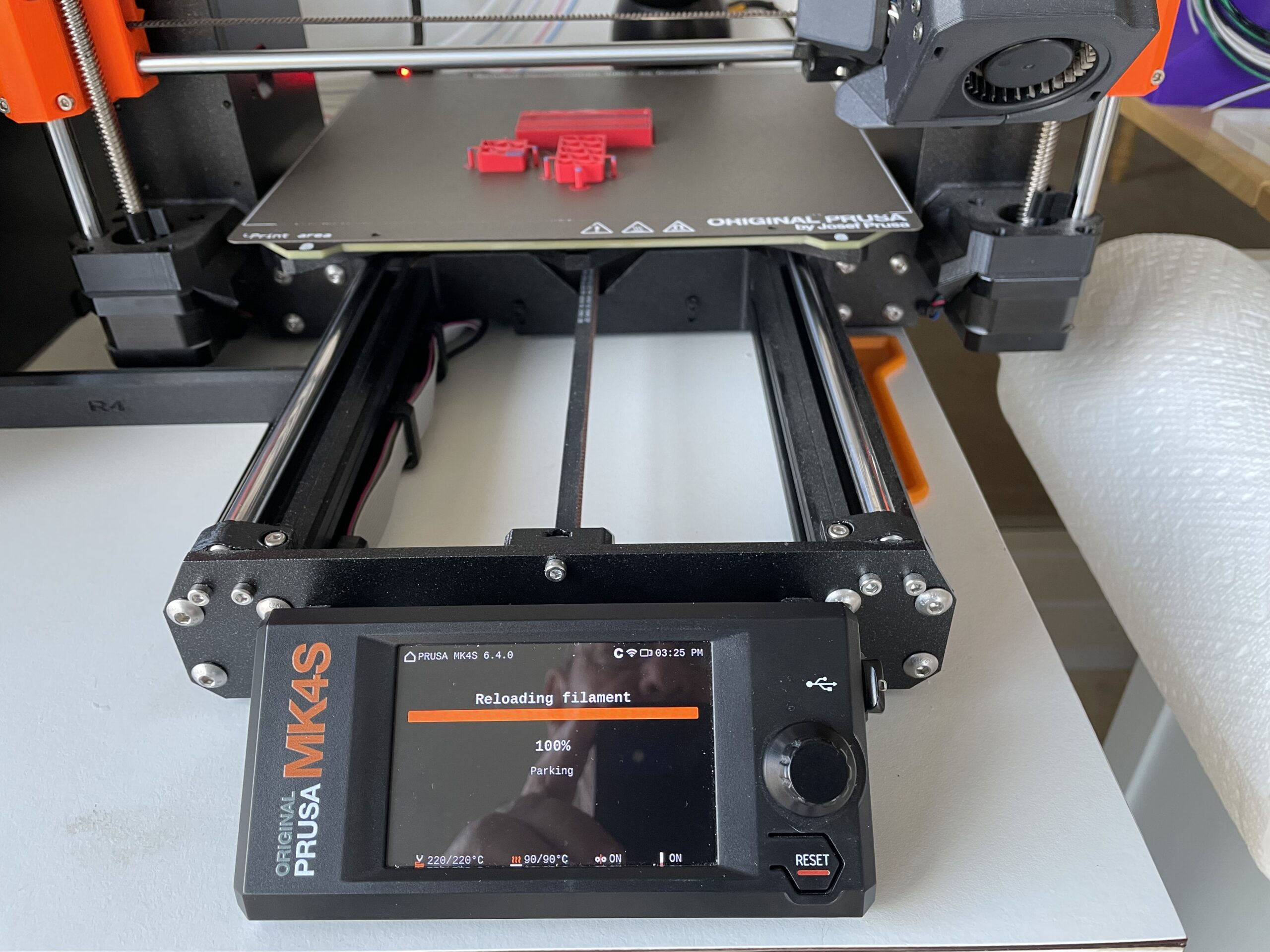
Today I had my first occurrence of "Filement wiederladen, 99%, Parke" (German for "Reloading Filament, 99%, parking") where the printer (MK4s+MMU3) got stuck. I have preloaded the filament to the print head and answered "No" when I was asked to change the filament.
After a reset and restart the print, the loaded filament was unloaded and reloaded correctly.